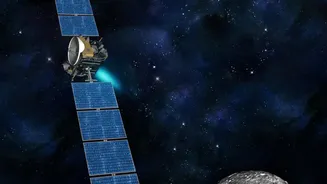






In 2022, NASA intentionally crashed a spacecraft into an asteroid. Now, years later, analysis reveals a startling consequence: the impact unleashed a swarm of massive boulders, fundamentally changing our understanding of planetary defense.
A Cosmic Punch for Planetary Defense
On September
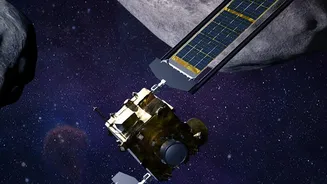
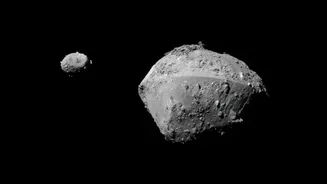
26, 2022, NASA's Double Asteroid Redirection Test (DART) mission made history. The van-sized spacecraft, travelling at a blistering 14,000 miles per hour, slammed into Dimorphos, a small moonlet orbiting the larger asteroid Didymos, millions of kilometres from Earth. The goal was not to destroy the asteroid, but to see if a 'kinetic impact' could nudge it, altering its path. It was humanity’s first-ever test of a planetary defense system, a dress rehearsal for a day when we might need to deflect a space rock on a genuine collision course with our planet. The mission was a spectacular success. Telescopes on Earth confirmed the impact shortened Dimorphos's orbit around Didymos by a stunning 33 minutes, far exceeding the mission's minimum goal of 73 seconds. This success was largely due to the recoil from a massive plume of dust and rock blasted from the asteroid's surface, which gave the rock an extra push.
An Unexpected Swarm of Boulders
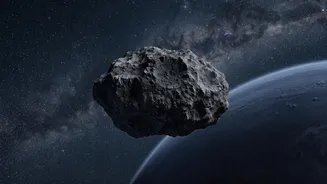
While the initial dust cloud was expected, long-term observation has revealed something far more surprising. Using the incredible sensitivity of the Hubble Space Telescope, astronomers have now identified a 'swarm of bees'—a cloud of at least 37 distinct boulders—drifting away from the battered asteroid. These aren't tiny pebbles; the boulders range in size from three feet to over 22 feet across. They are moving away from Dimorphos at a leisurely pace of about half a mile per hour, roughly the walking speed of a giant tortoise. These boulders are some of the faintest objects ever imaged within our solar system, a testament to Hubble's power. The discovery indicates that the impact was far more violent and consequential than just creating a crater, providing new intuition for the sheer force of the event.
What the Debris Tells Us
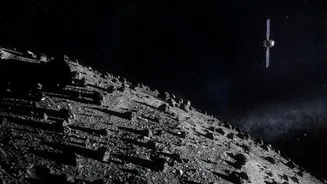
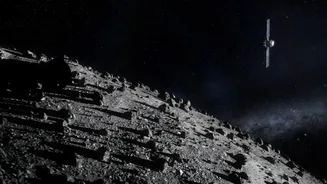
This cloud of wreckage offers crucial clues about the nature of asteroids like Dimorphos. Scientists believe these boulders were not created by the impact itself, but were already scattered across the asteroid's surface and were shaken loose by the collision's seismic energy—like hitting a bell with a hammer. This supports the theory that Dimorphos is not a solid, monolithic rock, but a 'rubble pile'—a loose collection of gravel and boulders held together weakly by gravity. The last images from the DART spacecraft just before impact showed a surface covered in such rocks. Understanding this 'rubble pile' structure is vital. If a dangerous asteroid is just a loose collection of rocks, hitting it might not just push it, but could also break it apart or, as DART showed, send a cascade of smaller (but still potentially hazardous) boulders into space.
A New Wrinkle in Planetary Defense
The discovery of the boulder swarm is a double-edged sword for planetary defense. On one hand, the fact that so much material was ejected means the kinetic impact technique is even more effective at changing an asteroid's momentum than previously thought. The recoil from the debris provides a significant force multiplier. On the other hand, it introduces a new complication: deflecting one large threat could create a cluster of smaller ones. The European Space Agency's Hera mission, which launched in October 2024, is now en route to the Didymos-Dimorphos system. Arriving in late 2026, Hera will perform a detailed 'crash scene investigation', studying the impact crater, the asteroid's composition, and this very boulder cloud, which will still be dispersing when it arrives. The new data from Hera shows DART flattened one side of Dimorphos, creating a stadium-sized crater and setting the moonlet tumbling chaotically.