


Solving a Galactic Mystery
For years, astronomers have been puzzled by a strange feature of our galaxy. While stars in the main disk orbit the galactic center at a brisk 220 kilometers per second, the stars in the vast, sparse cloud surrounding the disk—known as the stellar halo—are
moving much more slowly. This discrepancy was a major cosmic mystery. The answer, it turns out, lies in a cataclysmic event from our galaxy's infancy. Using powerful supercomputer simulations and data from the European Space Agency's Gaia mission, which meticulously maps the positions and motions of stars, astronomers at Durham University pieced together the clues. Their findings, presented at the Royal Astronomical Society's National Astronomy Meeting, point to a single, defining event: a massive, head-on collision.
The Gaia-Sausage Collision
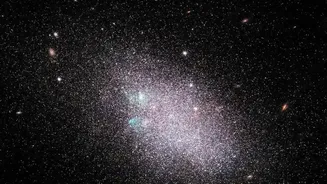
Roughly 10 to 11 billion years ago, when the Milky Way was still young, it was struck by a smaller, dwarf galaxy. This interloper, now known as Gaia-Sausage-Enceladus (or simply the "Sausage galaxy" due to the elongated, sausage-like orbits of its leftover stars), was no lightweight. It contained stars, gas, and dark matter totaling more than 10 billion times the mass of our sun. The term "collision" is slightly misleading; galaxies are so vast and mostly empty that individual stars rarely hit each other. Instead, the immense gravitational forces of the two galaxies tore the Sausage galaxy to shreds. The Milky Way absorbed its smaller rival, but the encounter left a permanent scar and fundamentally reshaped our home galaxy's structure.
Flipping the Galactic Disk
The computer simulations revealed a stunning consequence of this head-on merger. The sheer force of the impact likely caused the entire disk of the Milky Way to flip by more than 90 degrees. Imagine a spinning top being knocked by another object; its axis of rotation wobbles and reorients. A similar process, though on an unimaginable scale and taking hundreds of millions of years, happened to our galaxy. This "disk flip" provides the crucial explanation for the slow-moving stellar halo. The simulations showed that galaxies that experienced both a massive head-on collision and a subsequent disk flip ended up with slowly rotating haloes, just like the one observed in the Milky Way today.
The Aftermath We See Today
This ancient crash was the last major merger in the Milky Way's history and its impact is still visible. The debris from the shredded Sausage galaxy makes up a significant portion of the stellar halo that surrounds us. The collision also triggered a massive burst of star formation, a "galactic firework" that helped build up the Milky Way's population of stars. The central bulge of our galaxy was also fashioned by this event. The revelation that our galaxy was flipped on its side adds a dramatic new chapter to its life story. It implies that the paths of stars, possibly even our own Sun, were once very different. Our seemingly stable place in the cosmos might not have been so stable throughout its entire existence.