



Mehrangarh Fort, Jodhpur
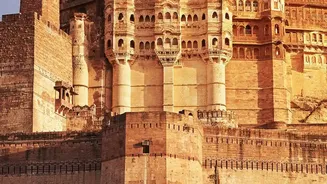
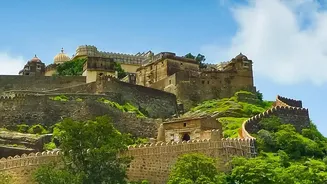
Perched on a 400-foot cliff, Mehrangarh Fort dominates the skyline of Jodhpur, the 'Blue City'. Founded in 1459 by Rao Jodha, this fort is one of India's largest and most formidable. Its massive walls, which seem to grow out of the rock itself, enclose
a complex of palaces known for their intricate carvings and expansive courtyards. Inside, the Moti Mahal (Pearl Palace) and Phool Mahal (Flower Palace) showcase the opulence of the Rathore dynasty. Rudyard Kipling aptly described it as a palace that might have been built by Titans. The fort's museum houses an impressive collection of royal artefacts, from palanquins to weaponry.
Red Fort, Delhi
A symbol of India itself, the Lal Qila, or Red Fort, is a UNESCO World Heritage site in the heart of Delhi. Commissioned by the Mughal emperor Shah Jahan in 1639, its towering red sandstone walls once enclosed the magnificent city of Shahjahanabad. The fort served as the main residence of Mughal emperors for nearly 200 years. Its architecture is a pinnacle of Mughal creativity, blending Persian, Timurid, and Hindu traditions. Within its walls lie architectural gems like the Diwan-i-Am (Hall of Public Audience) and the ornate private apartments connected by the Nahr-i-Behisht, or Stream of Paradise.
Amer Fort, Jaipur
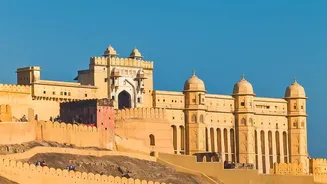
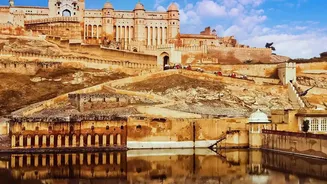
Overlooking Maota Lake, the honey-hued Amer Fort is a stunning example of Rajput architecture just outside Jaipur. Construction was started by Raja Man Singh I in the 16th century, and it combines Hindu and Mughal stylistic elements with effortless grace. The fort is famed for its artistic details, from cobbled paths to grand gates. The highlight for many is the Sheesh Mahal, or Mirror Palace. This mesmerising hall is covered in a mosaic of tiny mirrors that glitter like stars when a single flame is lit, a request made by a queen who wished to sleep under the stars.
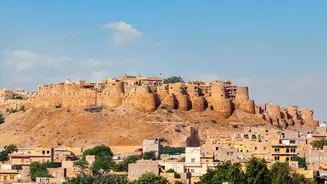
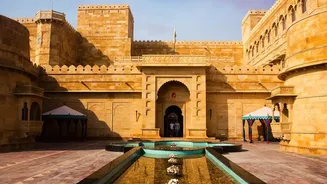
Jaisalmer Fort, Jaisalmer
Rising from the Thar Desert like a giant sandcastle, Jaisalmer Fort is often called Sonar Quila, or the Golden Fort. Built in 1156 by Rajput ruler Rawal Jaisal, what makes this UNESCO World Heritage site unique is that it is a 'living fort'. Thousands of people still reside within its ancient walls, amidst a labyrinth of narrow lanes, temples, shops, and houses. The fort's yellow sandstone walls appear to glow, changing from a lion-yellow during the day to a honey-gold as the sun sets, creating an unforgettable spectacle in the desert.
Golconda Fort, Hyderabad
Once the capital of the Qutb Shahi dynasty, Golconda Fort near Hyderabad is a marvel of engineering and acoustics. Originally a mud fort, it was expanded into a massive granite citadel in the 16th century. The fort was renowned as a major diamond trading centre, with gems like the Koh-i-Noor said to have passed through it. Its most famous feature is its incredible acoustic system; a clap at the main gate can be heard clearly at the Bala Hisar pavilion, the highest point almost a kilometre away, a feature designed as an ingenious warning system against attacks.
Chittorgarh Fort, Chittorgarh
As the largest fort in India, Chittorgarh is a sprawling complex that covers 700 acres atop a high hill. This UNESCO World Heritage site was the capital of the Mewar kingdom and is a symbol of Rajput pride, valour, and sacrifice. Its history is marked by three devastating sieges, most famously the one in 1303 by Alauddin Khilji, purportedly driven by his desire to capture the beautiful Queen Padmini. The fort complex houses magnificent structures like the Vijay Stambha (Tower of Victory) and the Rana Kumbha Palace, each narrating tales of heroism and tragedy.
Gwalior Fort, Gwalior
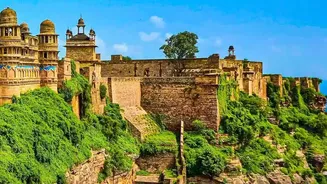
Described by the Mughal emperor Babur as "the pearl amongst the fortresses of Hind," Gwalior Fort has a history stretching back to at least the 6th century. The fort stands on an isolated rock, overlooking the city of Gwalior. Its defensive structure and numerous palaces, temples, and water tanks have been coveted by many dynasties over the centuries. A standout feature is the Man Mandir Palace, built by Raja Man Singh Tomar, with its stunning facade decorated with blue ceramic tiles. The fort also features immense rock-cut Jain sculptures carved into the cliff faces.