
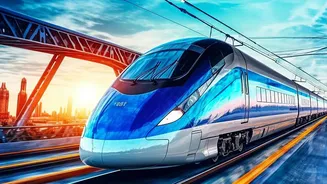


Viaducts and Piers Rise Across the Corridor
The most visible sign of progress on the 508-kilometre route is the sheer scale of civil construction. The National High Speed Rail Corporation Limited (NHSRCL), the agency implementing the project, has made significant headway, particularly in Gujarat.
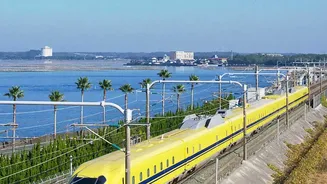
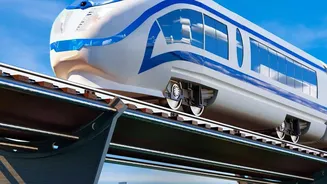
As of mid-2026, work on elevated viaducts, which will carry the train for most of its journey, is advancing rapidly. Pier work has been completed along hundreds of kilometers of the route, creating a 'necklace of concrete' that sketches the train's future path across the landscape. In Maharashtra, where progress was initially slower, construction has also gained momentum, with over 100 km of pier work now finished on the stretch between Shilphata and Zaroli village. This accelerated pace is crucial for meeting the project's phased commissioning deadlines.
Conquering Rivers and Rugged Terrain
Building a high-speed line capable of handling speeds of 320 km/h requires remarkable engineering, especially when crossing rivers and navigating difficult terrain. The project has involved the construction of numerous steel and concrete bridges. To date, 17 river bridges have been completed, showcasing the project's ability to overcome natural obstacles. In Maharashtra, a state known for its challenging topography, engineers have successfully completed complex mountain tunnels, another critical step toward ensuring the corridor's continuity from Mumbai to Ahmedabad. These engineering feats are not just about connecting two points; they are about creating a stable, resilient foundation for a new era of travel.
A Foundation Built for Speed
The secret to the bullet train's speed and safety lies in its track technology, based on Japan's famed Shinkansen system. India is implementing a 'slab track' system, where reinforced concrete beds are laid to ensure the extreme stability and alignment required for high-speed transit. This is a departure from the traditional ballasted tracks used on most conventional railways. The construction of this reinforced concrete (RC) track bed has been completed over more than 200 kilometers. At the same time, thousands of masts for the Overhead Equipment (OHE) have been installed, which will form the backbone of the electrical system powering the trains. These advanced systems are fundamental to achieving the project's ambitious performance goals.
Stations Designed as Modern Transit Hubs
The bullet train stations are being envisioned as more than just boarding points; they are being developed as integrated multimodal hubs. In Gujarat, stations in Surat, Vadodara, and Anand are already in advanced stages of construction. The Surat station, with a design inspired by the city's diamond industry, has its structural framework and roofing complete, with interior finishing now underway. In Vadodara, the station is being built directly above the existing Indian Railways platform, featuring foot-over-bridges with travelators to ensure seamless connectivity for passengers. Meanwhile, Mumbai's underground terminus at Bandra Kurla Complex (BKC) is nearing the completion of its foundation work, a major milestone for one of the most technically challenging sections.
The Final Stretch to 2027
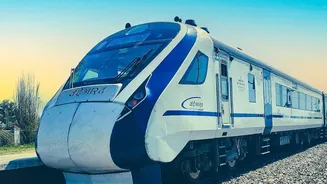
According to Union Railway Minister Ashwini Vaishnaw, the first trial runs are anticipated between May and June of 2027. These crucial tests will take place on a nearly complete section of the corridor, likely starting with the Surat-Bilimora or Surat-Vapi stretch in Gujarat. The first indigenous high-speed train's body frame has already been completed and sent for 'squeeze testing' to verify its structural integrity. Following a testing period of two to four months, the first passenger services are expected to be launched. This phased rollout means parts of the network could become operational even as work continues on the full 508-km line.