


Earth's Restless Surface
Our planet's outer shell is not one solid piece. It's broken into about a dozen major tectonic plates that drift across the semi-molten mantle below. These plates move at roughly the same speed your fingernails grow, but over millions of years, this movement
reshapes continents and oceans. Most of the planet's seismic activity happens where these plates meet. They can pull apart, grind sideways past each other, or, most consequentially, collide head-on. While all these interactions can cause tremors, the planet's most formidable earthquakes are born from a specific type of collision.
The Great Plunge: Subduction Zones
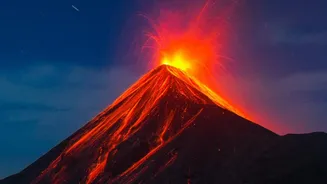
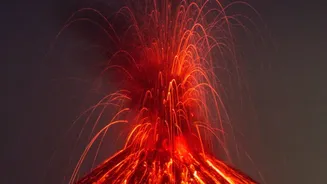
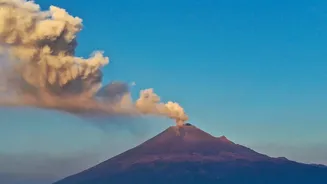
When two tectonic plates collide, the denser plate is forced to dive beneath the lighter one. This process is called subduction, and the area where it happens is a subduction zone. Think of it like a massive, geological conveyor belt where oceanic crust, which is denser, is constantly being recycled back into the Earth's mantle by sliding under continental crust. These zones are marked by some of the deepest oceanic trenches, like the Mariana Trench, and are often paralleled by towering volcanic mountain ranges or island arcs created by the intense heat and pressure.
The Megathrust Mechanism
The descent of one plate beneath another is anything but smooth. The immense friction between the two vast rock surfaces causes them to lock together. While the plates are stuck, the relentless forces of plate tectonics continue to push them, causing the overriding plate to get squeezed and warped, storing up an incredible amount of strain energy over decades or even centuries. Eventually, the stress becomes too great for the friction to hold, and the fault ruptures. This sudden, violent release of energy is what is known as a megathrust earthquake. The fault can slip by dozens of metres in a matter of minutes along a rupture that can be over 1,000 kilometres long.
Why These Quakes Are So Devastating
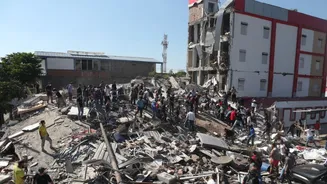
Megathrust earthquakes are the most powerful seismic events on the planet. Since 1900, every earthquake of magnitude 9.0 or greater has been a megathrust event. The 1960 Valdivia earthquake in Chile registered a magnitude of 9.5, the largest ever recorded, while the 1964 Alaska quake was a 9.2. More recently, the 2004 Sumatra-Andaman earthquake (magnitude 9.1-9.3) and the 2011 Tōhoku earthquake in Japan (magnitude 9.0-9.1) were both catastrophic megathrust events. Because these quakes occur offshore, the abrupt vertical movement of the seafloor displaces enormous volumes of water, generating devastating tsunamis that can travel across entire oceans.
Hotspots Around the 'Ring of Fire'
The vast majority of the world's subduction zones are located around the perimeter of the Pacific Ocean in a 40,000-kilometre-long, horseshoe-shaped belt known as the 'Ring of Fire'. This region is home to about 75% of the world's active volcanoes and experiences about 90% of its earthquakes. From the coast of South America, up through Central America and the West Coast of North America, across the Aleutian Islands of Alaska, and down through Japan, the Philippines, and New Zealand, populations live in the shadow of these powerful geological forces.