



From Supermassive to Stupendously Large
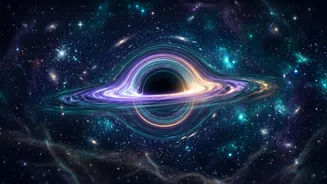
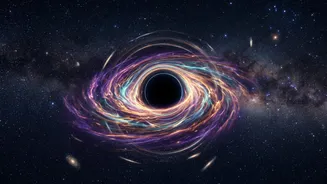
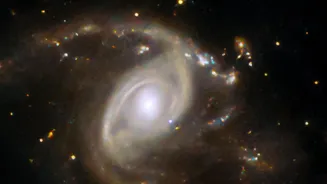
In the world of cosmic titans, 'supermassive' is the standard. Most large galaxies, including our own Milky Way, have a supermassive black hole at their center. The one in our galactic backyard, Sagittarius A*, is about 4 million times the mass of our sun.
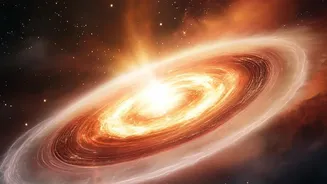
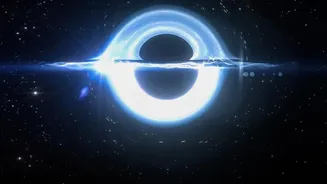
The largest confirmed black hole, powering a quasar named TON 618, clocks in at a staggering 66 billion solar masses. But now, some scientists are asking: what if there’s another, even bigger category? Enter the 'Stupendously Large Black Hole', or SLAB. This is a hypothetical class of black hole with a mass starting at 100 billion times that of the sun. These are not just slightly bigger; they are cosmic behemoths on a scale that pushes the boundaries of physics. While none have been definitively observed, their potential existence forces us to reconsider how the universe’s most massive objects came to be.
A Different Kind of Origin Story
So, how do you build a monster of this magnitude? The usual methods for creating supermassive black holes—the collapse of giant stars or the merger of smaller black holes over billions of years—might not be sufficient. Instead, the leading theory for SLABs suggests a much older origin. They might be 'primordial' black holes, formed not from stars, but from immense density fluctuations in the hot, soupy chaos of the early universe, just moments after the Big Bang. Unlike black holes born from stars, primordial ones are not limited by the size of their parent star. They could have formed with a wide range of initial masses, potentially including stupendously large ones. This 'direct collapse' model suggests these giants could have existed before the first galaxies even formed, waiting in the cosmic dark.
The Challenge of Finding a SLAB
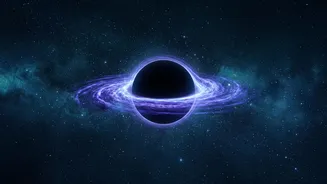
If SLABs exist, why haven't we found them? The primary challenge is that their most likely formation path makes them incredibly elusive. A black hole growing by the conventional method of consuming vast amounts of gas would be surrounded by an incredibly bright, hot accretion disk, making it visible as a brilliant quasar. But since primordial SLABs would have formed before most galaxies, they may not have a steady food source. They could be lurking quietly in the vast, empty spaces between galaxies, making them nearly invisible. Some scientists are now exploring unique ways to spot them. One idea is that a SLAB's enormous 'shadow' would be detectable as a cold spot against the cosmic microwave background—the faint afterglow of the Big Bang. Their immense gravity could also subtly distort this ancient light, providing another potential clue to their whereabouts.
Pushing the Limits of Physics
The existence of SLABs isn't just a curiosity; it would fundamentally challenge our understanding of the cosmos. For a long time, scientists theorized an upper limit for black hole growth at around 50 billion solar masses. This was based on the idea that beyond this point, the accretion disk that feeds a black hole becomes unstable and fragments into stars instead of fueling further growth. However, new models considering different conditions, like a black hole's spin, have suggested the limit could be higher, perhaps up to 270 billion solar masses. Finding a 100-billion-solar-mass black hole would provide concrete evidence that these extreme growth models are possible. It could also have profound implications for the mystery of dark matter, as some theories propose that primordial black holes of all sizes—including SLABs—could be a component of this enigmatic substance that makes up most of the matter in the universe.