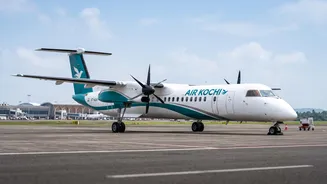








Kerala's ambitious plan for India's first co-operative airline has gained momentum, with government approval marking a key first step. At the heart of this venture, tentatively named 'Co-Keralam', is the strategic selection of Kochi as its home base.
A New Model for Indian Aviation
In late October 2026, the Kerala government officially approved a proposal for the Kerala Civil Aviation Development Cooperative Society to launch flight services. This marks a significant development, aiming to create India's first airline operating under a co-operative model. The project is spearheaded by C.N. Vijayakrishnan, a respected figure associated with the successful MVR Cancer Centre. The airline's financing model is as unique as its ownership structure. It proposes to raise around ₹400 crore not from the state government, but by inviting about 200 co-operative societies to invest ₹2 crore each. This approach mirrors the public-private partnership success of Cochin International Airport (CIAL) itself, which was funded by thousands of non-resident Indians. The stated goal is to enhance regional connectivity and provide more affordable air travel options.
Kochi: The Strategic Linchpin
The choice of Kochi as the operational base is no accident; it is a calculated decision rooted in powerful strategic advantages. Cochin International Airport (CIAL) is already Kerala's busiest airport, handling over 63% of the state's air passenger traffic. It boasts a robust network of domestic and international flights, making it an ideal launchpad. Crucially, Kochi serves as the centre of the strong travel corridor between Kerala and the Gulf countries, a route sustained by the large Keralite diaspora. This existing, high-volume traffic provides a ready-made market. Furthermore, CIAL's infrastructure, including its long runway capable of handling wide-bodied aircraft and its position as a focus city for major carriers, offers the new airline operational stability. The state's broader vision is to position CIAL as a global transit hub, leveraging its geographical advantage between the Middle East and the Far East.
The Initial Flight Plan
According to the initial proposal, 'Co-Keralam' plans to begin operations with two leased 72-seater aircraft. The network will focus on strengthening regional connectivity, a persistent gap in the Indian aviation market. The proposed routes from Kochi would connect to other cities within Kerala like Kozhikode and Kannur, as well as key destinations in neighbouring states, including Bengaluru, Chennai, Coimbatore, Mangaluru, and Madurai. This hub-and-spoke model, centred on Kochi, would offer passengers more direct travel options, bypassing the need to transit through larger, more congested airports for short-haul journeys. Proposed fares are projected to be in the range of ₹3,500 to ₹7,000, aiming to make regional air travel a more accessible option. Promoters also suggest a dynamic pricing model, offering last-minute unsold seats at a discount.
Navigating The Challenges Ahead
While the government's approval is a major milestone, the path to launching an airline is fraught with regulatory and financial hurdles. The aviation industry is capital intensive and operates on notoriously thin margins. The project must secure an Air Operator Certificate (AOC) from the Directorate General of Civil Aviation (DGCA), a process that is deliberately stringent and can take over a year. Beyond regulatory approvals, the new airline will face fierce competition from established giants like IndiGo and Air India, which dominate India's skies. The history of Indian aviation is littered with airlines that failed due to weak balance sheets, aggressive expansion, and intense price wars. For 'Co - Keralam' to succeed, it will need not only solid financial backing from its co - operative members but also a flawless operational strategy and a clear value proposition to attract and retain customers in a cut - throat market.