








Meet LHS 1140b: A 'Super-Earth' of Interest
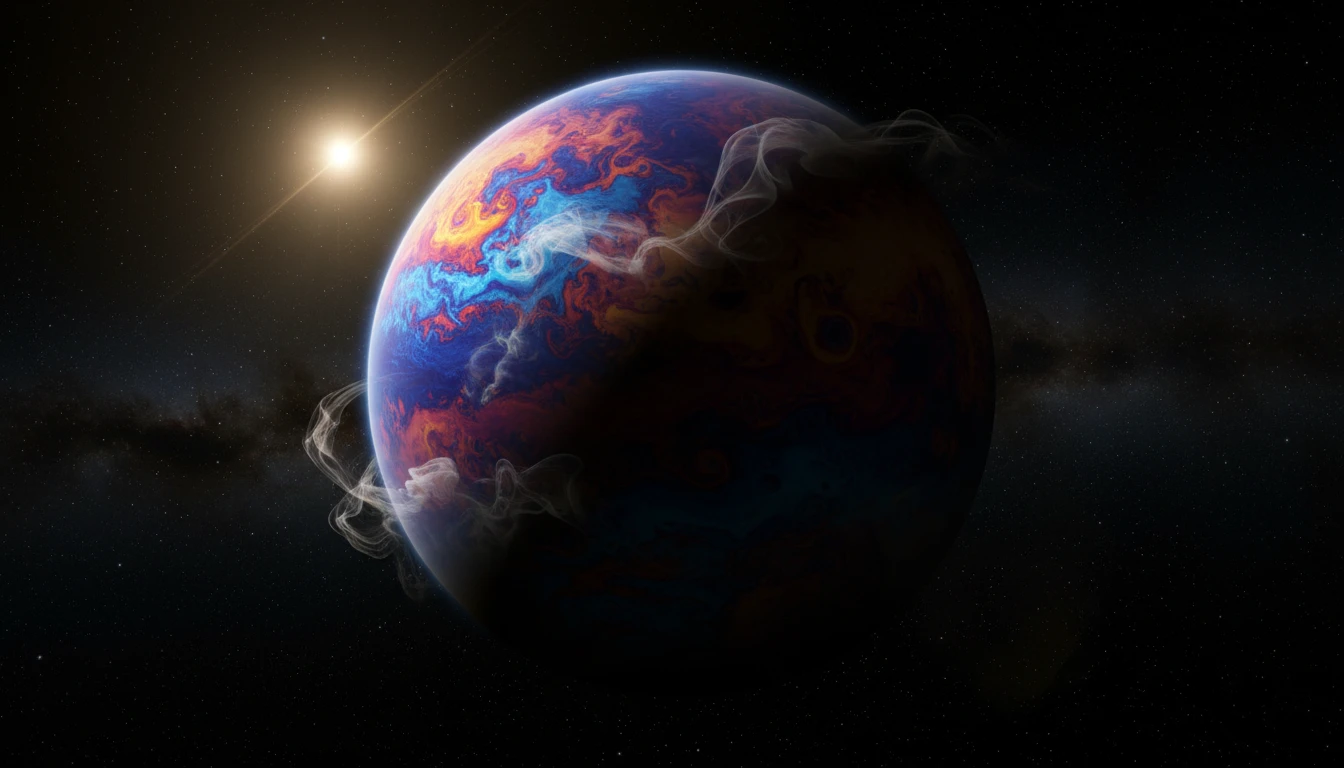
First discovered in 2017, LHS 1140b is a fascinating world orbiting a cool, dim red dwarf star. Located about 49 light-years from Earth in the constellation Cetus, it’s what astronomers call a 'super-Earth'—a planet more massive and larger than our own,
but still fundamentally rocky. It weighs in at about 5.6 times the mass of Earth with a radius roughly 70% larger. What makes LHS 1140b particularly special is its location. It orbits within its star's 'habitable zone', the temperate region where conditions could be just right for liquid water to exist on a planet's surface, a key ingredient for life as we know it. While its equilibrium temperature is a chilly -47 degrees Celsius, a thick atmosphere could create a greenhouse effect, raising surface temperatures significantly.
The Telltale Signature of Helium
The major breakthrough comes from the detection of helium. Using the Magellan Clay telescope in Chile, an international team of astronomers observed the planet as it passed in front of its star. During this transit, they found the unmistakable signature of helium gas escaping from the planet’s upper atmosphere. This is a landmark finding because it is the first confirmed detection of an atmosphere around a rocky planet in a habitable zone. While helium itself doesn't mean a planet is habitable, it acts as a powerful tracer. Detecting this light gas confirms that the planet has enough gravity and a protective magnetic field to hold onto a substantial atmospheric envelope over billions of years, a crucial requirement for habitability.
A Layered Atmosphere and Lingering Questions
The data suggests LHS 1140b has a complex, layered atmosphere. Scientists predict a helium-dominated upper layer that is slowly being stripped away by the star's radiation. However, this doesn't mean the planet is just a helium-filled rock. It's theorised that heavier, more life-friendly gases like nitrogen and water could be trapped in lower layers, closer to the surface. Previous observations with the James Webb Space Telescope (JWST) had ruled out a puffy, hydrogen-dominated atmosphere, which aligns with this new finding of a denser, more complex system. Interestingly, the helium escape appears to be variable; it was detected in 2024 observations but not in 2025, suggesting dynamic processes are at play.
Why This Discovery Matters for the Search for Life
For years, astronomers have found thousands of exoplanets, but the question of whether rocky worlds in habitable zones can retain their atmospheres has been a major unknown. Many orbit red dwarf stars, which are known for violent flares of radiation that can strip a planet's atmosphere away. The confirmation of an atmosphere on LHS 1140b provides a resounding 'yes'—it is possible. This makes it one of the most compelling targets for future study. It proves that planets that could potentially harbour liquid water are not necessarily barren, airless rocks. This finding moves the goalposts from simply finding planets to beginning the detailed characterisation of their environments.
What Comes Next for LHS 1140b?
This discovery is just the beginning. The presence of helium opens the door for a more intensive search for other, heavier gases in the atmosphere of LHS 1140b. The planet is a prime target for follow-up observations with powerful instruments like the James Webb and Hubble space telescopes. Scientists will now focus on searching for biosignatures—gases like oxygen, methane, and carbon dioxide—that could hint at biological or geological activity. While there is no evidence of life on LHS 1140b, the fact that it has an atmosphere makes it one of the most important natural laboratories we have for understanding how habitable worlds might form and evolve across the galaxy.