





Picture a berry. Chances are, you imagined a sweet, red, heart-shaped strawberry. It’s the poster child for berries, yet in the world of botany, it’s an imposter. The truth about what makes a berry a 'berry' is stranger than you think.
The Botanical Definition of a Berry
Before we expose
the strawberry, let’s define what botanists look for in a 'true berry'. The rules are quite specific. A berry must be a fleshy fruit that develops from a single flower containing a single ovary. This fruit must have its seeds embedded on the inside. Botanists identify three distinct layers: the outer skin (exocarp), the fleshy middle (mesocarp), and the inner part that holds the seeds (endocarp). A grape is a perfect example. It has a thin skin, a juicy middle, and contains seeds, all originating from one flower's single ovary. This strict definition is where our common understanding begins to unravel.
Why Strawberries Don't Make the Cut
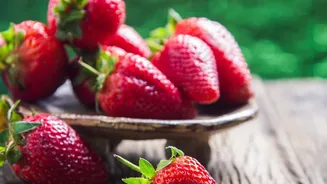
So, what is a strawberry if not a berry? Botanically, it’s known as an 'aggregate accessory fruit'. Let's break that down. It's an 'accessory' fruit because the red, fleshy part we love to eat doesn't grow from the flower’s ovary at all; it develops from the flower's receptacle, the part that holds the reproductive organs. It's an 'aggregate' fruit because it comes from a single flower that had hundreds of individual ovaries. Each of those tiny 'seeds' on the outside of a strawberry is actually a separate fruit called an achene, and inside each achene is the real seed. So, a single strawberry is a collection of many tiny, individual fruits.
The Case of Raspberries and Blackberries
Strawberries aren't alone in this botanical deception. Their close relatives, raspberries and blackberries, are also imposters in the berry world. Like strawberries, they are classified as aggregate fruits. Each little juicy globule on a raspberry or blackberry is a 'drupelet', and the whole thing is a cluster of these drupelets. Each drupelet contains a seed and developed from one of the many ovaries in the single flower. The next time you pick a raspberry and it leaves a little hollow cone behind, you're seeing the receptacle it grew around—a key difference from blackberries, where the receptacle stays inside the fruit when picked.
Surprise! Meet the Real Berries
Here's where things get really interesting. While strawberries and raspberries are out, a surprising number of other fruits are in. Bananas are technically berries because they grow from a single ovary and, in their wild form, are full of seeds. Other unexpected members of the berry club include grapes, tomatoes, eggplants, kiwis, and even avocados. And it doesn't stop there. Watermelons, cucumbers, and pumpkins are also a special type of berry called a 'pepo', while oranges and lemons are a leathery-rinded berry subtype known as a 'hesperidium'. It seems the berry family is much larger and more diverse than most of us ever imagined.
So Why Do We Call Them Berries?
If the botanical definitions are so clear, why is our everyday language so different? The answer lies in the difference between scientific classification and culinary use. In the kitchen and at the grocery store, we classify fruits based on how they taste and how we use them. The term 'berry' in a culinary sense usually refers to any small, soft, juicy, and sweet fruit without a stone. This practical, user-friendly definition lumps strawberries, raspberries, and blueberries together, even though botanically they are worlds apart. It's a classic case of science and everyday life having two different, but equally valid, ways of looking at the same thing.