







A Major Push for Clean Energy
The Union Cabinet has approved the Pradhan Mantri Surya Sarovar Yojana (PM-SSY), a landmark ₹5,070-crore initiative. The scheme aims to add 5,000 megawatts (MW) of floating solar photovoltaic (FSPV) capacity across the country. Crucially, each of these
projects will be paired with an energy storage system, creating a combined capacity of at least 10,000 megawatt-hours (MWh). This dual approach tackles two key challenges in the green energy transition: efficient use of space and the intermittent nature of solar power. The programme is expected to be rolled out between 2026 and 2031, significantly boosting India’s current floating solar capacity from around 700 MW.
What Are Floating Solar Farms?
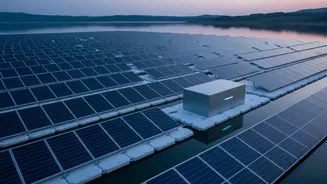
Floating solar, sometimes called 'floatovoltaics', involves mounting solar panels on buoyant platforms anchored in water bodies like reservoirs, lakes, and dams. This technology offers several key advantages over traditional ground-mounted solar farms. Firstly, it conserves valuable land, a critical benefit for a densely populated country. Secondly, the water's cooling effect on the panels can enhance their efficiency and power generation. Furthermore, the solar arrays can help reduce water evaporation from reservoirs, conserving a precious resource. Despite these benefits and an estimated national potential of over 102 gigawatts (GW) on water bodies, adoption has been relatively slow. This new scheme aims to change that by providing financial incentives and a clear framework for development.
The Game-Changer: Adding Battery Storage
The mandatory inclusion of battery energy storage systems (BESS) is what makes the PM-SSY scheme particularly transformative. Solar power is inherently variable; it is only generated when the sun is shining. This intermittency can create instability in the electricity grid. By co-locating batteries with the solar panels, excess energy generated during peak sunshine hours can be stored and then dispatched to the grid when demand is high or after sunset. This turns a variable renewable source into a firm, dispatchable power supply, available 24/7. It enhances grid stability, reduces reliance on fossil fuel-based power plants for backup, and allows for better utilisation of transmission infrastructure.
De-risking and Boosting Domestic Manufacturing
To accelerate adoption, the government is offering significant financial support. This includes Central Financial Assistance of ₹1 crore per MW for successfully commissioned projects and up to ₹50 lakh per project for essential preparatory work like feasibility studies and environmental assessments. This upfront support is designed to 'de-risk' the projects for developers, addressing historical bottlenecks that have slowed progress. The scheme is also expected to catalyse domestic manufacturing of key components like floating platforms, solar cells, and battery systems, aligning with the government’s Aatmanirbhar Bharat (self-reliant India) vision. The government estimates the initiative will create between 16,000 and 17,000 jobs.
Powering India’s Green Future
From the massive 600 MW Omkareshwar Floating Solar Project in Madhya Pradesh to installations in Kerala, Telangana, and Andhra Pradesh, India has already demonstrated its capability in this sector. The PM-SSY scheme builds on this foundation, aiming for a seven-fold increase in capacity. By leveraging existing water bodies, the program not only helps India move closer to its ambitious target of 500 GW of non-fossil fuel electricity capacity by 2030 but does so in a sustainable and efficient manner. This integrated approach of combining floating solar with energy storage provides a powerful blueprint for the future of renewable energy in India and across the world.