


A Planet in a Bizarre Place
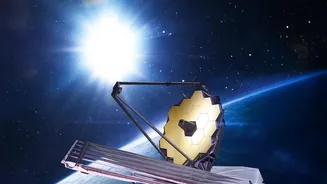
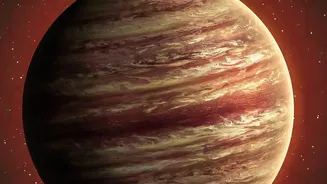
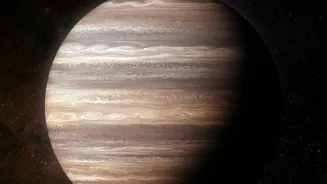
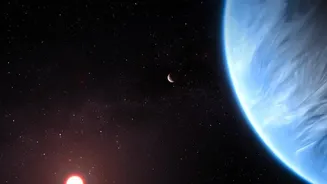
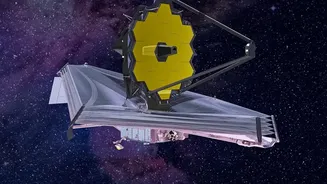
Scientists have pointed the powerful infrared eye of the JWST towards a Jupiter-mass world known as PSR J2322-2650b. While finding new planets is becoming almost routine, this one is different. It orbits a pulsar, which is the super-dense, rapidly spinning
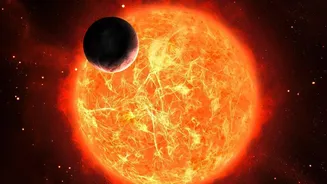
remnant of a massive star that has died. These stellar corpses are tiny—about the size of a city but with more mass than our sun—and they blast out intense beams of radiation. Simply finding a planet that has survived in such an extreme environment is remarkable, but it is the planet’s atmosphere that has truly stumped the scientific community.
An Atmosphere of Soot and Carbon
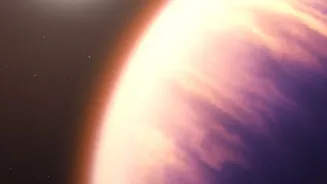
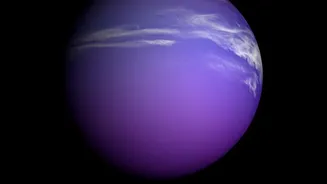
When astronomers received the data from Webb, their collective reaction was one of pure shock. Instead of an atmosphere composed of hydrogen and helium, which is typical for a gas giant, or even other common molecules like water or methane, they found something completely alien: an atmosphere dominated by carbon and helium. Researchers described clouds of soot floating through the air, a composition that has never been seen on any other planet. The lead investigators were taken by surprise, with one admitting their reaction was, “What the heck is this?” It was a genuine mystery that didn't fit any of their expectations.
A World of Potential Diamonds
The details only get stranger. The carbon in the atmosphere exists in molecular forms like dicarbon and tricarbon, which are elements more commonly associated with the tails of comets or even the chemistry of flames here on Earth. This unique composition leads to a tantalizing possibility. Scientists theorize that deep within the planet's atmosphere, the immense pressure could be great enough to compress the floating soot clouds, causing carbon to condense and form actual diamonds. This world is not only unlike anything in our solar system, but it also appears to be a type of planet previously only imagined in theory.
The Puzzle of a 'Black Widow' Survivor
To understand why this discovery is so groundbreaking, you have to know the planet's violent history. The system is known as a “black widow,” where the powerful pulsar has spent millions of years stripping away material from its companion planet with its intense gravity and radiation. According to established theories, this brutal process should leave behind a planetary remnant rich in helium, the result of the star’s outer layers being vaporized. The discovery of a carbon-rich atmosphere on PSR J2322-2650b directly challenges these models. It presents a clear contradiction that scientists now have to explain, forcing a major rethink of how planets evolve—and survive—in some of the most hostile environments in the universe.
A New Chapter in Planetary Science
This bizarre, lemon-shaped world, distorted by the immense gravitational pull of its parent star, is more than just a curiosity; it’s a laboratory for new science. Discoveries like this are precisely what the James Webb Space Telescope was built for. It was designed not just to confirm what we know, but to find things that we can't easily explain. Each puzzle it uncovers, from the earliest galaxies to impossible planets, pushes the boundaries of our knowledge. For now, PSR J2322-2650b remains a profound anomaly, a planet that seemingly shouldn’t exist. Scientists will continue to study it, hoping to unlock the secrets of its formation and, in doing so, gain a deeper understanding of the universe’s capacity for creating strange and wonderful new worlds.