



Why the Pool Comes First
A scuba certification course, like those offered by PADI or SSI, is structured to build your skills progressively and safely. This journey starts with 'confined water' training, which usually takes place in a swimming pool or a very calm, shallow body
of water with pool-like conditions. The purpose is to provide a controlled, stress-free environment where you can get comfortable with the equipment and practice essential skills. In a pool, you can stand up if you need to, which builds confidence and allows you to focus purely on the task at hand without worrying about currents or visibility. This is where you will assemble your gear, take your first breaths underwater, and master the procedures that will become second nature in the open sea.
Mask, Snorkel, and Fins: Your Underwater Windows and Engine
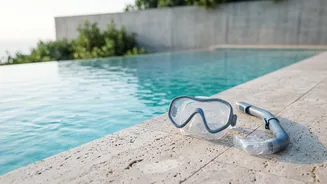
The most personal pieces of gear are your mask, snorkel, and fins. Your mask provides the air space in front of your eyes needed to see clearly underwater. A key skill learned in the pool is 'mask clearing'—purging water from a partially or fully flooded mask without surfacing. You'll also practice swimming without a mask to prove you can handle the situation calmly if it's ever knocked off. Your fins act as your engine, allowing you to move through the water with efficiency. In the pool, you'll learn different kicking techniques to maximize propulsion and minimize energy use. The snorkel is used for breathing at the surface to conserve air in your tank before you descend.
The BCD: Mastering Buoyancy
The Buoyancy Control Device, or BCD, is the jacket that holds your scuba tank and allows you to control your position in the water. Think of it as an inflatable vest connected to your air tank. By adding small bursts of air from the tank via an inflator hose, you can become positively buoyant and float on the surface. By releasing air, you become negatively buoyant and can descend. The ultimate goal, which you will practice extensively in the pool, is achieving 'neutral buoyancy'—a state of hovering weightlessly in the water. Mastering the BCD is fundamental to protecting fragile marine life, conserving energy, and moving with grace underwater.
The Regulator: Your Life Support System
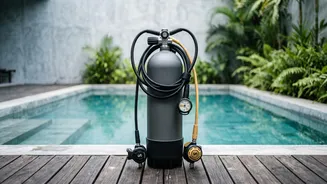
The regulator is the ingenious device that makes breathing underwater possible. It connects to your tank and converts the high-pressure air inside to a breathable pressure. Your primary regulator consists of a first stage, which attaches to the tank, and a second stage, which is the part you breathe from. You'll also have an 'octopus' or alternate air source—a backup second stage, usually bright yellow, with a longer hose. This is for sharing air with a buddy in an emergency. Pool training involves numerous drills like recovering your regulator if it falls out of your mouth and practicing how to share air with a partner while stationary and while swimming.
Gauges and Computer: Your Underwater Dashboard
Being a safe diver means always knowing your status. During your confined water dives, you'll learn to read your instrument console. The most critical instrument is the Submersible Pressure Gauge (SPG), which tells you how much air is left in your tank. You will learn to check it frequently and communicate your remaining air to your buddy. Alongside the SPG, you will use a dive computer. This wrist-mounted or console-integrated device tracks your depth, dive time, and calculates your safe bottom time to prevent decompression sickness. Getting familiar with its display and alerts in the controlled setting of a pool is essential before you rely on it in open water.
Weights and Exposure Suit: Getting Comfortable
Humans are naturally buoyant, especially when wearing a wetsuit. To descend, you'll need to wear lead weights. These can be on a weight belt or in integrated pockets within your BCD. During your pool session, your instructor will help you determine the correct amount of weight needed to achieve neutral buoyancy. You will also practice skills like removing and replacing your weight system at the surface and underwater. Finally, you’ll get used to wearing an exposure suit, typically a wetsuit, which provides thermal insulation to keep you warm and protects your skin. Getting all this gear on and learning how it feels is a major part of your initial training.