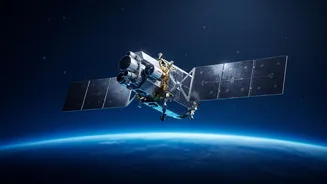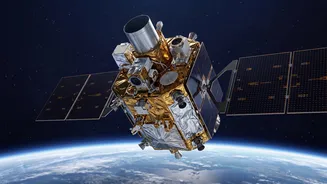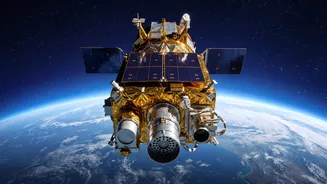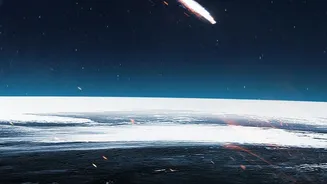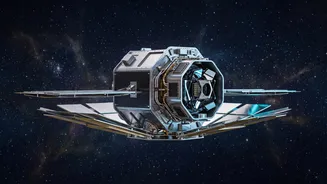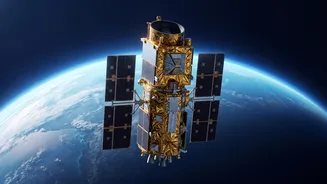




After nearly 22 years of unlocking cosmic secrets, NASA's Neil Gehrels Swift Observatory concluded its mission with a dramatic re-entry over Indonesia on November 4. This marks the end of an era for a workhorse telescope that changed our view of the universe.
A Fiery Farewell
On November 4, 2026, the 1.5-ton Swift Observatory plunged back to Earth, burning up as it streaked through the atmosphere over the North Sumatra region of Indonesia. The final descent was an uncontrolled but expected event, marking the formal end of a mission that far outlived its planned two-year lifespan. The observatory's orbit had been decaying for years, a process accelerated recently by increased solar activity that caused Earth's atmosphere to expand and create more drag. An ambitious last-minute commercial rescue mission this past summer, intended to boost Swift into a higher orbit, unfortunately failed, sealing the satellite's fate. Mission operators sent the final commands to shut down the spacecraft on October 20, as it became too low to maintain a stable orientation for scientific observations.
An Eye on the Violent Universe
Launched in November 2004, the Swift Gamma-Ray Burst Explorer was designed with a singular, agile purpose: to solve the mystery of gamma-ray bursts (GRBs). These are the most powerful explosions in the cosmos, brief but incredibly intense flashes of energy appearing from random directions in the sky. The observatory was named 'Swift' not as an acronym, but for its ability to rapidly pivot and focus its instruments on a newly detected burst, often in less than 90 seconds. This speed was revolutionary. For the first time, astronomers could study the fading afterglow of these violent events in X-ray, ultraviolet, and optical light, providing crucial data before the evidence vanished.
Solving Cosmic Mysteries
Swift's primary legacy is its role in classifying GRBs. The observatory's data helped confirm that 'long' bursts, lasting more than two seconds, are typically caused by the collapse of massive stars into black holes. 'Short' bursts, which can last mere milliseconds, were linked to the cataclysmic collisions of dense stellar remnants like neutron stars. In 2005, Swift made history by capturing the first ever Xray afterglow from a short GRB, a breakthrough that helped solidify the neutron star merger theory. During its operational life, Swift detected over 2,000 gamma ray bursts, providing an unprecedented catalogue of these extreme cosmic phenomena.
More Than a One Trick Pony
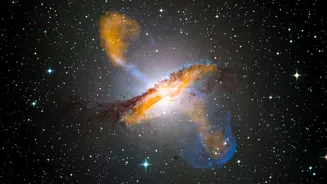
While designed to hunt GRBs, Swift's rapid response capabilities made it an indispensable multi purpose tool for astronomers worldwide. It served as a 'first responder' for other major observatories like the Hubble and James Webb Space Telescopes, flagging transient events for deeper investigation. Beyond GRBs, Swift studied over 1,400 supernovae, monitored stars being torn apart by black holes, and even observed comets and asteroids within our own solar system. Its work contributed to roughly 7,000 scientific papers, a testament to its incredible return on investment and its broad impact on nearly every area of astrophysics.