





A Renter's Best Friend
For those living in temporary spaces, the desire to make a house a home is strong, but the limitations can be frustrating. Oversized textiles—like tapestries, large scarves, quilts, or even beautiful rugs—offer a powerful solution. They provide an immediate
and dramatic visual update, capable of transforming a sterile room into a personal sanctuary. Unlike framed art, which can be heavy and require significant hardware, a large piece of fabric brings softness, texture, and movement to a space. It can absorb sound, making a room feel calmer and quieter, and cleverly hide any imperfections on the wall. Best of all, it’s a non-permanent commitment; when it’s time to move, you simply take it down and pack it away, leaving the wall exactly as you found it. This makes it an ideal strategy for renters in apartments across India who want style without structural changes.
Finding the Perfect Fabric
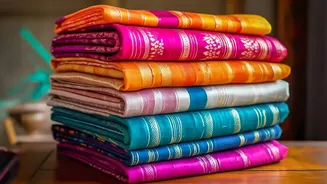
The term 'oversized textile' is wonderfully broad, giving you endless creative freedom. You can opt for a traditional woven tapestry for a bohemian feel or a graphic-print fabric for a modern aesthetic. In an Indian context, the options are particularly rich and varied. Think of a vintage Kantha quilt with its intricate stitching, a vibrant Bandhani piece, or an elegant silk sari. Even a beautiful block-printed bedcover or a lightweight cotton quilt can be repurposed as wall art. The key is to consider the weight and the mood. Lighter fabrics like cotton and silk are easier to hang and create a soft, flowing effect. Heavier pieces like wool rugs or densely embroidered textiles add a sense of warmth and luxury. Don't be afraid to think outside the box; a beautiful piece of fabric you love for its pattern or sentimental value can become the room's stunning centrepiece.
The Art of Pulling Colour
To create a cohesive look, the textile shouldn't exist in isolation. The most successful designs pull colours from the room's existing decor. Start by identifying the main colours in your space—your sofa, cushions, curtains, or other significant furniture. Your chosen textile should share at least one or two of these hues. This creates a visual link that makes the new addition feel intentional and harmonious. A good approach is to follow a simple design principle: select a dominant colour, a secondary colour, and an accent colour for your room. Your textile can feature your secondary or accent colour to tie everything together. For instance, if your living room has a neutral beige sofa and blue cushions, a large textile that features shades of blue and beige with a pop of a complementary colour like mustard yellow can add energy without feeling chaotic.
Damage-Free Installation
The biggest concern for any renter is how to hang something large without leaving a mark. Fortunately, there are several reliable, damage-free methods. For lightweight fabrics, heavy-duty removable adhesive strips or hooks are a game-changer. It’s crucial to clean the wall with rubbing alcohol first to ensure a strong bond and to check the weight limit on the product packaging. For a more decorative approach, you can use adhesive hooks to hold a series of clothespins or binder clips, which then grip the top of the fabric. This method allows for easy swapping. For heavier textiles, a tension rod fitted inside a narrow alcove or between two walls can work wonders, allowing you to drape the fabric over it like a curtain. Another effective method involves using self-adhesive Velcro strips attached to both the wall and the textile, providing a secure, flush mount that is completely removable.
More Than Just a Wall Hanging
The versatility of large textiles extends beyond just being wall decor. A beautiful piece of fabric can be strategically draped over a bland or worn-out sofa, instantly giving it a new lease on life. You can use a decorative ladder to display a collection of throws or quilts, adding texture and interest to an empty corner. A particularly long piece of fabric can be hung from the ceiling using removable hooks to act as a soft room divider, creating distinct zones in a studio apartment without building walls. It can also serve as a creative headboard behind a bed, adding a soft, luxurious backdrop. By thinking of large textiles as a flexible design element, you can solve multiple decorating dilemmas in a rental home with a single, beautiful piece.