



A Ghost in the Solar Machine
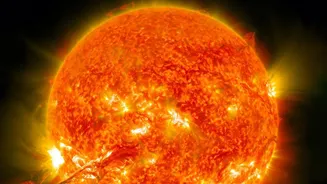
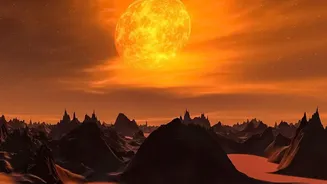
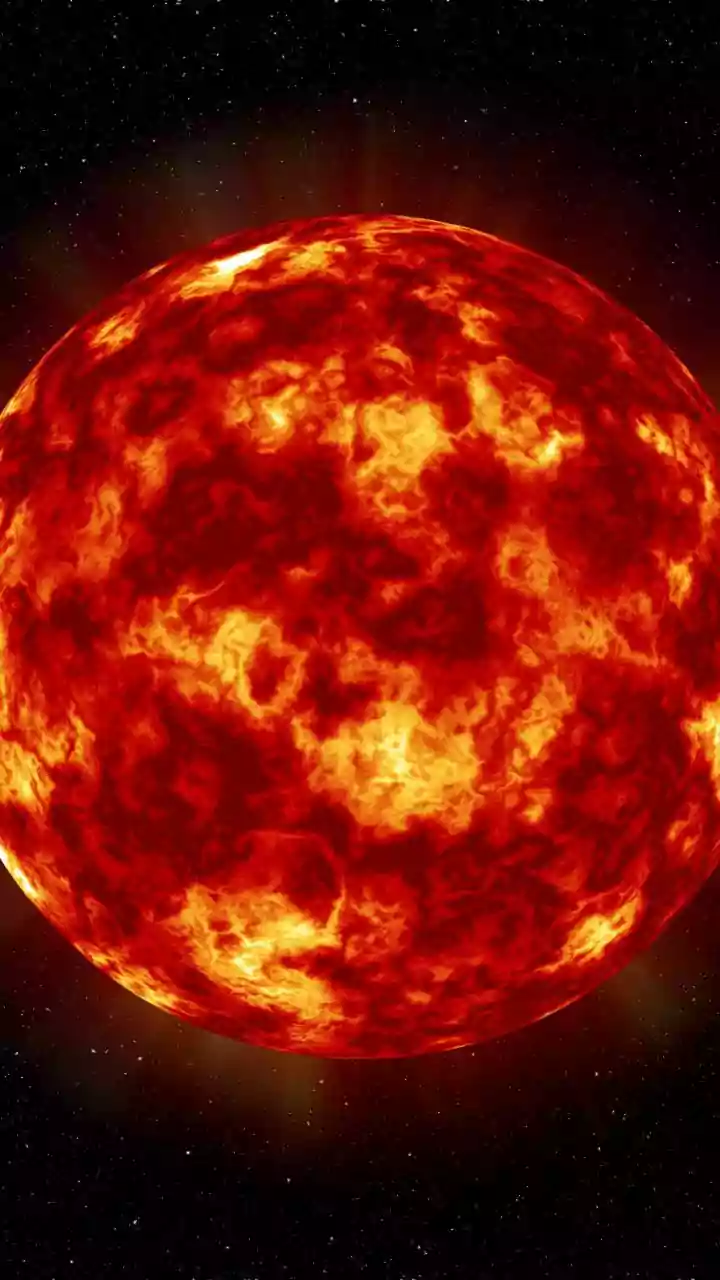
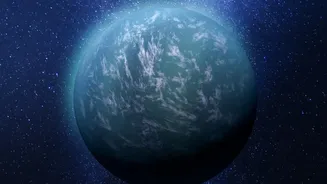
The theory sounds like science fiction: billions of years ago, a large, rocky planet, perhaps five to ten times the mass of Earth, spiraled into our young sun and was consumed. This isn't just a wild guess. A recent study published in the Monthly Notices
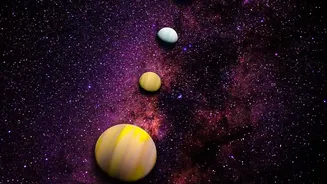
of the Royal Astronomical Society proposes that such an event could solve several long-standing puzzles about the sun's composition and internal structure. The research, led by scientists from Ege University in Turkey, used computer simulations to model the sun's evolution. They found that the ingestion of a so-called "super-Earth" could neatly explain why standard models of the sun don't perfectly match observations. This lost world could also be the answer to another mystery: why our solar system lacks super-Earths, a type of planet that appears to be very common in other star systems.
The Solar System's Chaotic Youth
To understand how a planet could fall into the sun, we have to rewind to the early days of the solar system, roughly 4.5 billion years ago. It was a cosmic pinball machine, a far cry from the orderly system we know today. Proto-planets were forming from a swirling disk of gas and dust, and their orbits were not yet stable. Gravitational nudges from larger bodies, like a migrating Jupiter, could have easily pushed smaller worlds onto catastrophic new paths. We already have a major theory involving a planetary collision from this era: the giant-impact hypothesis. This theory suggests that a Mars-sized planet named Theia slammed into a proto-Earth, and the debris from that cataclysmic event eventually formed our Moon. It’s not a huge leap to imagine that while one planet hit Earth, another might have been knocked into the sun.
The Search for Chemical Fingerprints
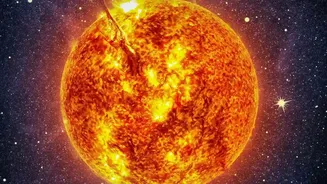
If the sun did consume a planet, it wouldn't just vanish without a trace. A rocky planet is made of different, heavier elements than the hydrogen and helium that make up the vast majority of the sun. The new study argues these heavier materials would have sunk beneath the sun's turbulent outer layer, leaving a lasting chemical imprint. This could explain two key anomalies. First is the sun's surprisingly low level of surface lithium, an element that is easily destroyed by high temperatures; a planetary collision could have altered the mixing processes that churn the sun's interior, causing more lithium to be dragged down and burned. Second, it could correct subtle mismatches between the observed speed of sound waves traveling through the sun's interior and what the standard models predict.
The All-Important Qualification
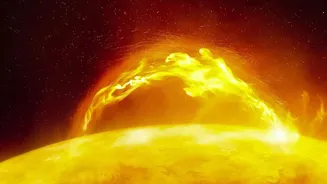
Here's the key qualification to keep in mind: this is a theory based on computer modeling, not a direct discovery. Proving it is incredibly difficult. The sun is a dynamic, violent place. Its outer third is a churning convection zone where hot plasma constantly rises and cooler plasma sinks, a process that would dilute or erase any foreign chemical signatures over billions of years. The evidence of a consumed planet would exist deep inside the sun, far from where we can easily observe. Scientists believe the best way to search for these clues is through helioseismology—the study of vibrations, or sound waves, rippling through the sun's interior. By precisely measuring these waves, they might be able to detect subtle structural differences that point to a layer of foreign material. However, even if anomalies are found, proving they came from a planet and not some other unknown solar process will be the next great challenge.