






Why a Star Defines its Planets
A planet is fundamentally a product of its stellar environment. The old mantra in real estate, "location, location, location," is just as true for exoplanets. A star dictates the amount of light and heat a planet receives, which determines if liquid water
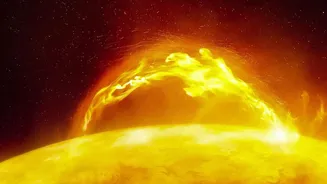
could exist on its surface. But the relationship goes much deeper. The star's own life cycle, its stability, and its composition have a direct and powerful influence on the planets that orbit it. A star prone to violent flares could strip a nearby planet of its atmosphere, rendering it barren. A star's age can tell us if a planet has had enough time for complex life to potentially evolve. In short, you cannot truly know the planet without first knowing the star.
A New Generation of Cosmic Surveyors
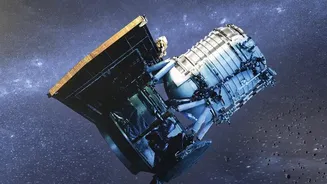
Recognizing this deep connection, space agencies have developed missions specifically designed to study both planets and their host stars simultaneously. A prime example is the European Space Agency's PLATO mission, which stands for PLAnetary Transits and Oscillations of stars. Scheduled to launch in 2026, its main goal is to find and study rocky planets, especially those in the habitable zone around stars similar to our Sun. At the same time, NASA recently began science operations with its Pandora mission, a small satellite designed to untangle the light from a planet's atmosphere from the light of its host star, solving a key problem in understanding atmospheric composition.
Two Kinds of Science from One Signal
These missions primarily hunt for planets using the transit method, watching for the tiny, repetitive dip in a star's brightness caused by a planet passing in front of it. This dip reveals the planet's size. But that same starlight carries a wealth of information about the star itself. By studying the subtle variations in the star's light over time, scientists can perform asteroseismology—the study of "starquakes." These are sound waves that ripple through a star's interior, causing it to vibrate. Analyzing these vibrations allows scientists to determine a star's mass, size, and, most importantly, its age with incredible precision—details that are impossible to get from simple observation alone.
The Search for a True 'Earth 2.0'
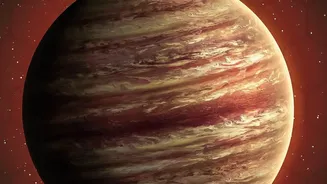
This dual approach is critical for moving beyond simply detecting planets to actually characterizing them. For a planet to be considered truly "Earth-like," we need to know its density. Is it a rocky world like Earth, or a puffy gas planet like a mini-Neptune? To calculate density, you need both the planet's size (from the transit) and its mass. A planet's mass is often calculated by measuring the gravitational "wobble" it induces in its star. However, this calculation is only as accurate as our knowledge of the star's mass. By using asteroseismology to nail down the star's properties, missions like PLATO can provide the data needed to determine a planet’s mass and radius with precisions of 10% and 3% respectively, allowing for a much clearer picture of its true nature.
Building a Catalogue of Worlds
The ultimate goal is to build a comprehensive catalogue of planetary systems. Instead of just a list of planets, we will have detailed portraits of entire families of worlds and their parent stars. This will revolutionize our understanding of how planetary systems form and evolve. We'll be able to compare systems of different ages, around different types of stars, to see what conditions are most favorable for the emergence of worlds like our own. Missions like PLATO and Pandora are laying the essential groundwork, identifying the most promising targets for even more powerful observatories like the James Webb Space Telescope to study in greater detail. They are shifting the paradigm from planet-finding to planet-understanding, bringing us closer to answering one of the most profound questions: are we alone?