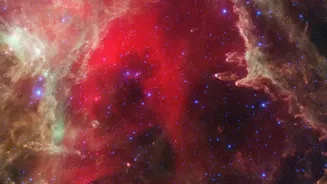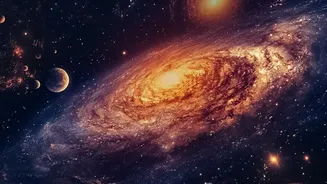




When we picture outer space, we often imagine a perfect, silent void—an absolute emptiness between the stars and galaxies. But the reality is far more interesting. The cosmos is not completely empty; it is filled with a tenuous but vital mixture of gas
and dust.
The Emptiness We Imagine
The idea of space as a total vacuum is a common one. A perfect vacuum is a volume containing no particles of any kind. While the space between celestial bodies is the closest natural approximation to a perfect vacuum we know, it doesn't quite get there. Compared to the dense atmosphere on Earth, where a single cubic centimetre contains trillions upon trillions of molecules, the sparseness of space is almost incomprehensible. However, even in the most remote stretches of the cosmos, there is still something there. This 'something' is known to scientists as the interstellar medium (ISM) within galaxies, and the intergalactic medium (IGM) between them.
Meet the Interstellar Medium
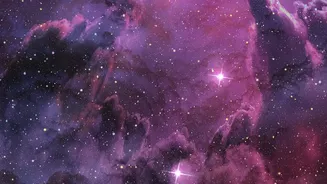
The interstellar medium is the material that drifts in the vast regions between the stars inside a galaxy like our own Milky Way. About 99% of this medium is gas, and the other 1% is dust. The gas is overwhelmingly composed of the two simplest and most abundant elements in the universe: hydrogen (about 90%) and helium (about 8%). The remaining fraction includes trace amounts of heavier elements like oxygen, carbon, and iron, which were forged inside past generations of stars and cast out into space when those stars died. The density varies wildly. In some cold, dense 'molecular clouds', there can be up to a million particles per cubic centimetre. In hotter, more diffuse areas, the density can drop to just a handful of particles in the same volume. By contrast, even the best vacuums created in labs on Earth contain thousands of particles per cubic centimetre.
The Cosmic Nursery for Stars
This thin gas and dust is far more than just cosmic filler; it is the fundamental building block for future generations of stars and planets. Within the coldest, densest parts of the interstellar medium, known as molecular clouds, gravity begins to pull material together. These clouds of gas and dust collapse under their own weight, forming dense pockets that heat up as they compress. Eventually, the core of one of these collapsing clumps becomes so hot and dense that nuclear fusion ignites, and a new star is born. The dust plays a crucial role, providing surfaces for gas molecules to meet and combine, and shielding these stellar nurseries from the harsh radiation of other stars. In essence, the 'empty' space between stars is where all future stars are waiting to be created.
The Even Emptier Space Between Galaxies
If the space between stars is nearly empty, the space between entire galaxies—the intergalactic medium—is even more so. Here, the average density can drop to as low as one atom per cubic metre. It is a vast, tenuous sea of mostly ionized hydrogen gas, heated to extreme temperatures by the radiation from galaxies and the shockwaves of cosmic structure formation. Yet even this incredibly sparse medium is not a true void. It contains the majority of the universe's 'normal' matter (as opposed to dark matter and dark energy) and forms a vast cosmic web of filaments that connects galaxies. Galaxies are not isolated islands; they are constantly interacting with this intergalactic medium, pulling in gas to fuel star formation and expelling material through stellar winds and supernova explosions.