






Meet SPHEREx: The Sky-Mapping Explorer
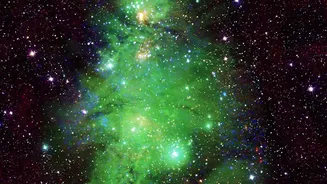
SPHEREx, which stands for Spectro-Photometer for the History of the Universe, Epoch of Reionization, and Ices Explorer, is a NASA space telescope with a grand ambition. Launched in March 2025, its primary job is to map the entire sky multiple times over
its two-year mission. It does this in infrared light, which is invisible to the human eye but perfect for peering through cosmic dust. By creating a detailed, multicolour map of the cosmos, SPHEREx is designed to tackle some of the biggest questions in astronomy, including how the universe began and how galaxies evolve. As a powerful side project, the telescope is also perfectly suited to study some of the dimmer, cooler objects in our galactic neighbourhood.
What Exactly Is a 'Failed Star'?
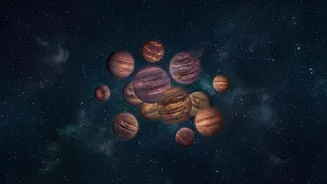
The term 'failed star' refers to an object called a brown dwarf. These celestial bodies are fascinating because they blur the line between a giant planet like Jupiter and a small star. Like stars, brown dwarfs are born from the collapse of a massive cloud of gas and dust. However, they never accumulate enough mass to ignite the sustained nuclear fusion of hydrogen in their cores, which is the process that makes stars shine brightly. While they aren't true stars, they are much more massive than planets—ranging from about 13 to 80 times the mass of Jupiter. They drift through space as solitary, dimly glowing balls of gas, heated by the leftover energy from their formation rather than a parent star.
The Landmark Discovery
In a recent study published in The Astrophysical Journal, scientists used SPHEREx to analyse the light from 37 nearby brown dwarfs. Because SPHEREx observes in infrared and can split light into 102 different colours, it can detect the chemical fingerprints of molecules in their atmospheres. The analysis revealed that these 'goth' worlds, as one scientist described them, have chemically rich atmospheres. Specifically, the team confirmed the presence of water, methane, carbon monoxide, and carbon dioxide. This discovery provides an unprecedented look into the atmospheric chemistry of these strange objects across a wide range of temperatures.
Why Finding Water and Methane Matters
Finding these molecules is significant because it helps astronomers test and refine their models of how planetary and stellar atmospheres work. Brown dwarf atmospheres are like natural laboratories—they are simpler to study than the atmospheres of exoplanets, which are often obscured by the blinding light of their host stars. The SPHEREx data showed that while current atmospheric models are good at predicting general chemical trends, they struggle to explain the details, especially during a transitional phase when a brown dwarf's clouds thin out and its atmosphere becomes rich in methane. Scientists were surprised to find that no two brown dwarfs are exactly alike; even at the same temperature, their spectra can be quite different.
Building Blocks of Life in Unexpected Places
One of SPHEREx's overarching goals is to search for the origins of water and other key ingredients for life in the universe. While the presence of water and methane on a brown dwarf doesn't imply it could host life, it reinforces the idea that these fundamental molecules are common throughout the cosmos. This information helps scientists understand the inventory of materials available in the galaxy for the formation of new stars and planets. Some researchers even speculate that life, while not possible on the surface, could theoretically exist in the upper atmospheric layers of a brown dwarf where temperatures and pressures are more Earth-like. This discovery, therefore, is not just about failed stars, but about understanding the universal distribution of life's essential building blocks.