








A Visionary Mission Takes Flight
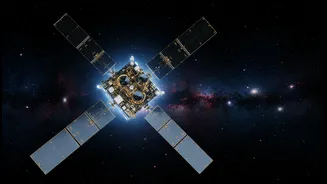
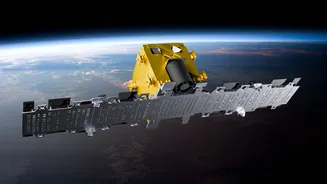
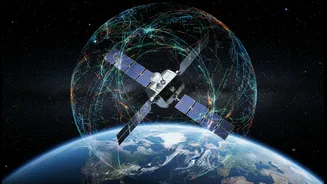
On May 3, 2026, the Indian private space sector marked a major milestone. Mission Drishti, the country's largest privately built Earth observation satellite, successfully lifted off aboard a SpaceX Falcon 9 rocket. Developed by Bengaluru-based startup
GalaxEye, the 190 kg satellite was more than just a piece of hardware; it was a symbol of India's rising ambition in the global space economy. The mission drew praise from national leaders and industry experts, celebrated as a leap forward for sovereign technology. Its goal was revolutionary: to provide a kind of all-seeing eye from orbit.
The OptoSAR Breakthrough
What made Mission Drishti special was its unique payload, the world's first 'OptoSAR' system. Traditional satellites face a trade-off. Optical satellites provide clear, intuitive images but are useless in darkness or when clouds get in the way. Synthetic Aperture Radar (SAR) can pierce through clouds and work at night, but its data is complex and less straightforward to interpret. Mission Drishti's innovation was to combine both on a single platform, capturing optical and SAR data of the same location, at the same time. This 'fused' imagery promised unprecedented, analysis-ready insights for everything from disaster management during floods to defense surveillance and precision agriculture.
Initial Success, Then Silence
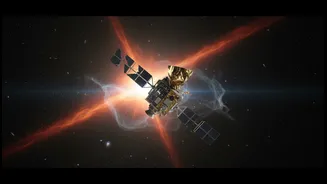
In the crucial days following the launch, everything seemed to be going according to plan. The satellite successfully deployed, established communications with GalaxEye's mission control in Bengaluru, and began its Launch and Early Orbit Phase (LEOP). The team validated critical systems like attitude control and onboard computing. But during the final stage of this commissioning phase, something went wrong. Communications became intermittent before cutting out completely. The celebrated mission had run into a formidable and unseen adversary.
The Invisible Force of Space Weather
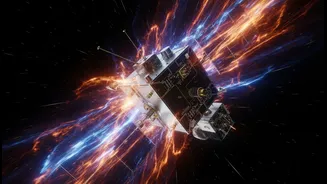
The culprit was a powerful geomagnetic storm—a dramatic display of what is known as space weather. Triggered by activity on the Sun, like solar flares and coronal mass ejections (CMEs), space weather sends streams of charged particles and radiation hurtling across the solar system. When these storms hit Earth, they interact with our planet's magnetic field and upper atmosphere. While this can create beautiful auroras, it can be catastrophic for satellites. The effects can range from frying sensitive electronics to altering a satellite's orbit.
How a Solar Storm Kills a Satellite
For a satellite in low Earth orbit, a geomagnetic storm can be fatal in several ways. The storm heats Earth's thin upper atmosphere, causing it to expand. This increases atmospheric drag, acting like a brake on the satellite, causing it to lose altitude and potentially re-enter the atmosphere and burn up. This exact phenomenon caused the loss of 38 Starlink satellites in February 2022. Another danger is radiation. High-energy particles can disrupt or permanently damage a satellite's electronic components, leading to system failures. GalaxEye's initial investigation suggests that radiation from the storm likely affected a critical onboard subsystem on Mission Drishti, leading to the anomaly.
A Setback, Not a Failure
While the company has stated that the likelihood of recovering the satellite is low, GalaxEye's leadership has framed the mission as a valuable learning experience. In a statement, the company confirmed that Mission Drishti had already validated several key technologies and provided invaluable engineering insights that will be used to strengthen future missions. The incident serves as a harsh but vital lesson for the entire space industry, particularly as it launches more and larger constellations into orbit. It underscores the critical need for better space weather prediction and more resilient satellite designs. The story of Mission Drishti is a cautionary tale of the inherent risks of space exploration, where success is never guaranteed and the universe always has the final say.