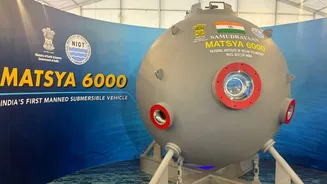

Union Minister of State (MoS) for Science & Technology Jitendra Singh on Tuesday, December 10, announced this ambitious project, which aims to put India among the few nations with ultra-deep sea exploration capability.
In a post on X, he wrote, “Here is India’s ambitious plan to send one human deep-sea submersible, providentially around the same time when preparations are in the final stage to send a human into Space. Meet #Matsya6000,India’s first indigenously developed human deep sea submersible, showcased by the Ministry of Earth Sciences #MoES at #IISF2025.”
The Matsya 6000 submersible is targeting its first 500-meter manned dive by 2026 and a 6,000-meter dive by 2027.
Here is India’s ambitious plan to send one human deep sea submersible, providentially around the same time when preparations are in final stage to send a human into
the Space.
Meet #Matsya6000,India’s first indigenously developed human deep sea submersible, showcased by Ministry… pic.twitter.com/DE0q6AC4OO
— Dr Jitendra Singh (@DrJitendraSingh) December 9, 2025
Under the Government of India’sDeep Ocean Mission initiatives, the Ministry of Earth Sciences has tasked the National Institute of Ocean Technology with designing and developingMatsya 6000, a 4th-generation deep-ocean human scientific submersible built as part of the Samudrayan Project.
The submersible is capable of carrying three people to a depth of 6,000 meters beneath the ocean surface. This advanced vehicle, outfitted with a wide range of scientific instruments and exploration tools, will enable extensive deep-sea research.
The submersible is designed to operate for 12 hours and can last up to 96 hours in an emergency. It includes advanced equipment such as a high-density Li-Po battery, an underwater acoustic telephone, bio-vests for crew safety and health monitoring, and drop-weight emergency escape mechanisms.
Earlier, the Ministry of Earth Sciences announced that Matsya 6000 was a major attraction at the India International Science Festival (IISF 2025) in Panchkula.
On X, it wrote, “As India’s marquee ocean submersible, it highlights the nation’s leap in marine exploration, enabling scientists to study some of the deepest regions of the ocean and opening new frontiers in the blue economy, innovation, and technology.”
Our very own Matsya 6000, the driver of India’s deep-ocean research, takes centre stage at the IISF 2025 exhibition.
As India’s marquee ocean submersible, it highlights the nation’s leap in marine exploration, enabling scientists to study some of the deepest regions of the… pic.twitter.com/Pa5GKqXwIf
— MoES GoI (@moesgoi) December 8, 2025
According to Ramesh Raju, a member of the Indian Ocean Science and Technology team attending the IISF, "Only four countries worldwide have the apparatus that can dive deeper than 6,000 meters, and India is one of these countries capable of transporting explorers to depths of 6,000 meters with the Matsya 6000.”
"Atmospheric pressure increases by every 10 meters in water. Consequently, the pressure increases significantly at 6,000 meters. However, the Matsya 6000 has been designed to handle this pressure easily," he was quoted as saying by ETV Bharat.
To unravel the mysteries of the ocean, two aquanauts – Ramesh Raju and Jatinder Pal Singh – from the National Institute of Ocean Technology (NIOT) will pilot the 28-tonne indigenously built manned submersible up to 500 metres deep off the Chennai coast early next year as part of India’s Deep Ocean Mission.