




What is the story about?
For solar eclipse chasers and astronomy enthusiasts, February 2026 promises an extraordinary celestial spectacle. The first solar eclipse of the year is set to occur on Tuesday, February 17, 2026. This will be an annular solar eclipse, widely known as the ‘Ring of Fire’ eclipse.
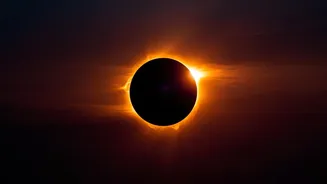
During an annular eclipse, the Moon passes directly in front of the Sun but does not completely cover it, leaving a bright circular ring of sunlight visible around the Moon. This striking visual effect has fascinated astronomers and eclipse watchers around the world.
But for those inIndia, this eclipse will not be visible, meaning local viewers will miss the ‘ring of fire’ spectacle. Nevertheless, astronomers and sky watchers worldwide will eagerly track and capture this breathtaking astronomical phenomenon.
Solar Eclipse 2026: The ‘Ring of Fire’ Spectacle
In a post, NASA explained that the ‘Ring of Fire’ phenomenon occurs when the Moon passes in front of the Sun but appears slightly smaller, leaving a glowing ring of sunlight around its edges.
NASA stated, “Anannular solar eclipse happens when the Moon passes between the Sun and Earth, but when it is at or near its farthest point from Earth. Because the Moon is farther away from Earth, it appears smaller than the Sun and does not completely cover the Sun. As a result, the Moon appears as a dark disk on top of a larger, bright disk, creating what looks like a ring around the Moon.”
Date and time
The first solar eclipse of 2026 is set to take place on February 17. According to Space.com, the eclipse’s ‘Ring of Fire,’ when the Moon covers 96% of the Sun’s centre, will last for around two minutes and 20 seconds.
Astronomical calculations reportedly indicate that the entire event will span more than two hours. As per reports, the eclipse will begin with a partial phase at 9:56 am UTC (3:26 pm IST).
The annular phase, when the Sun forms the iconic ‘Ring of Fire,’ will start at 11:42 am UTC (5:12 pm IST). The peak of the eclipse, offering the clearest view of the ring, is expected at 12:12 pm UTC (5:42 pm IST). The eclipse will fully end by 2:27 pm UTC (7:57 pm IST).
Visibility
The 2026 annular solar eclipse will not be visible from India, so there will be no direct visual impact and no need for traditional eclipse precautions in the country. Astronomy enthusiasts in India can still follow the event online through live streams and coverage from international space agencies and observatories.
According to space.com, the annular eclipse will be visible from a remote part of Antarctica. While only a few will witness the full annular phase, observers across the rest of Antarctica, including passengers on late-season cruise tours, will be able to see a partial solar eclipse.
Additionally, parts of southern Africa and the southern tip of South America will also experience a partial view of the eclipse.
The best place to see the event will likely be Concordia Station, a joint French-Italian research facility in the interior of Antarctica. Concordia houses just 16 scientists and is one of the coldest locations on Earth, with temperatures dropping as low as −80°C, according to space.com.
For most people, witnessing the full annular eclipse will be extremely difficult, but mid-February coincides with the end of the Antarctic cruising season, meaning a well-timed cruise could allow tourists along the Antarctic Peninsula to catch a partial solar eclipse.
During an annular eclipse, the Moon passes directly in front of the Sun but does not completely cover it, leaving a bright circular ring of sunlight visible around the Moon. This striking visual effect has fascinated astronomers and eclipse watchers around the world.
But for those inIndia, this eclipse will not be visible, meaning local viewers will miss the ‘ring of fire’ spectacle. Nevertheless, astronomers and sky watchers worldwide will eagerly track and capture this breathtaking astronomical phenomenon.
Solar Eclipse 2026: The ‘Ring of Fire’ Spectacle
In a post, NASA explained that the ‘Ring of Fire’ phenomenon occurs when the Moon passes in front of the Sun but appears slightly smaller, leaving a glowing ring of sunlight around its edges.
NASA stated, “Anannular solar eclipse happens when the Moon passes between the Sun and Earth, but when it is at or near its farthest point from Earth. Because the Moon is farther away from Earth, it appears smaller than the Sun and does not completely cover the Sun. As a result, the Moon appears as a dark disk on top of a larger, bright disk, creating what looks like a ring around the Moon.”
Date and time
The first solar eclipse of 2026 is set to take place on February 17. According to Space.com, the eclipse’s ‘Ring of Fire,’ when the Moon covers 96% of the Sun’s centre, will last for around two minutes and 20 seconds.
Astronomical calculations reportedly indicate that the entire event will span more than two hours. As per reports, the eclipse will begin with a partial phase at 9:56 am UTC (3:26 pm IST).
The annular phase, when the Sun forms the iconic ‘Ring of Fire,’ will start at 11:42 am UTC (5:12 pm IST). The peak of the eclipse, offering the clearest view of the ring, is expected at 12:12 pm UTC (5:42 pm IST). The eclipse will fully end by 2:27 pm UTC (7:57 pm IST).
Visibility
The 2026 annular solar eclipse will not be visible from India, so there will be no direct visual impact and no need for traditional eclipse precautions in the country. Astronomy enthusiasts in India can still follow the event online through live streams and coverage from international space agencies and observatories.
According to space.com, the annular eclipse will be visible from a remote part of Antarctica. While only a few will witness the full annular phase, observers across the rest of Antarctica, including passengers on late-season cruise tours, will be able to see a partial solar eclipse.
Additionally, parts of southern Africa and the southern tip of South America will also experience a partial view of the eclipse.
The best place to see the event will likely be Concordia Station, a joint French-Italian research facility in the interior of Antarctica. Concordia houses just 16 scientists and is one of the coldest locations on Earth, with temperatures dropping as low as −80°C, according to space.com.
For most people, witnessing the full annular eclipse will be extremely difficult, but mid-February coincides with the end of the Antarctic cruising season, meaning a well-timed cruise could allow tourists along the Antarctic Peninsula to catch a partial solar eclipse.