







What is the story about?
An Indian space firm, through its space division, has demonstrated the ability to photograph an object already in orbit - using another satellite. The test target: theInternational Space Station.
The experiment took place on February 3. Azista, an Ahmedabad-based private company, used its 80-kg Earth observation satellite, AFR. Two passes were planned. Both worked.
Azista space ISS imaging test: What happened
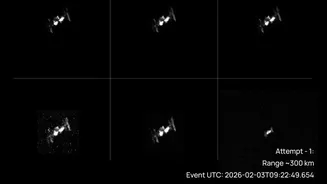
The ISS is large and predictable, but still fast. AFR tracked it during two separate windows - first at roughly 300 km distance, then closer to 245 km. The sensor had to lock onto a moving object while near the Earth’s horizon and under sunlit conditions, which adds glare and tracking difficulty.
Azista says AFR captured 15 usable frames at about 2.2-metre sampling. The company described both attempts as fully successful, validating its onboard tracking software and electro-optical systems. The term used internally: Non-Earth Imaging, or NEI.
Managing Director Srinivas Reddy said AFR now supports customers in remote sensing and has shown that ‘fully indigenous systems’ can track and characterise orbital objects. He noted these capabilities form the base of future space situational awareness payloads, NDTV reported.
What is SSA, and why does this matter?
Space situational awareness - SSA - means knowing where satellites are, what they are doing, and whether they are approaching other objects. Traffic in low-Earth orbit is rising. So is competition.
India operates more than 50 satellites across communications, navigation and Earth observation, per TOI. Monitoring nearby activity matters, especially during tense geopolitical periods.
While ISRO has previously shown rendezvous and tracking capability, this marks a private-sector step into that domain.
About the AFR satellite and future plans
AFR launched on June 13, 2023, aboard a Falcon 9 mission. Azista says the satellite remains operational and has years of life left. Beyond SSA demonstrations, it provides naval imaging, night imaging and video modes for civilian and defence clients.
The company is developing next-generation payloads aiming for much finer resolution - potentially down to 25 cm - from a new facility in Ahmedabad.
The experiment took place on February 3. Azista, an Ahmedabad-based private company, used its 80-kg Earth observation satellite, AFR. Two passes were planned. Both worked.
Azista space ISS imaging test: What happened
The ISS is large and predictable, but still fast. AFR tracked it during two separate windows - first at roughly 300 km distance, then closer to 245 km. The sensor had to lock onto a moving object while near the Earth’s horizon and under sunlit conditions, which adds glare and tracking difficulty.
Azista says AFR captured 15 usable frames at about 2.2-metre sampling. The company described both attempts as fully successful, validating its onboard tracking software and electro-optical systems. The term used internally: Non-Earth Imaging, or NEI.
Azista
Space Demonstrates Space Situational Awareness (SSA)/Non-Earth Imaging (NEI) using AFR: Imaging the International Space Station (ISS)!
Azista Space successfully executed a challenging near-horizon demonstration targeting the International Space Station (ISS). Operating in… pic.twitter.com/k6wt0mQJrD
— Azista Space (@azistaspace) February 6, 2026
Managing Director Srinivas Reddy said AFR now supports customers in remote sensing and has shown that ‘fully indigenous systems’ can track and characterise orbital objects. He noted these capabilities form the base of future space situational awareness payloads, NDTV reported.
What is SSA, and why does this matter?
Space situational awareness - SSA - means knowing where satellites are, what they are doing, and whether they are approaching other objects. Traffic in low-Earth orbit is rising. So is competition.
India operates more than 50 satellites across communications, navigation and Earth observation, per TOI. Monitoring nearby activity matters, especially during tense geopolitical periods.
While ISRO has previously shown rendezvous and tracking capability, this marks a private-sector step into that domain.
About the AFR satellite and future plans
AFR launched on June 13, 2023, aboard a Falcon 9 mission. Azista says the satellite remains operational and has years of life left. Beyond SSA demonstrations, it provides naval imaging, night imaging and video modes for civilian and defence clients.
The company is developing next-generation payloads aiming for much finer resolution - potentially down to 25 cm - from a new facility in Ahmedabad.