






What is the story about?
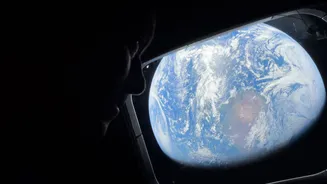
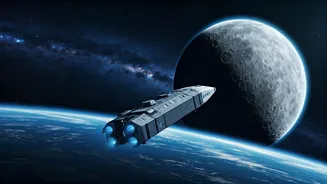
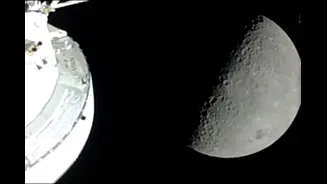
In a historic moment for space exploration, NASA’s Artemis II mission is set to carry astronauts around the Moon for the first time in over 50 years. The highly anticipated lunar flyby will take place on Monday, April 6. It will be streamed live across multiple platforms, allowing viewers worldwide to witness the milestone event in real time.
Where to watch Artemis II Live
The Artemis II lunar flyby will be broadcast live on NASA’s official streaming service NASA+, as well as platforms like YouTube, Amazon Prime Video, Apple TV, Hulu, and others. Live coverage is scheduled to begin at 1 pm EDT (10:30 pm IST ) on April 6.
Viewers can also tune in to NASA’s official YouTube channel for continuous 24/7 mission updates.
Key Timings of the Lunar Flyby (IST)
Monday, April 6 (EDT) / Monday–Tuesday IST
Tuesday, April 7 (EDT) / Tuesday IST
Crew and mission highlights
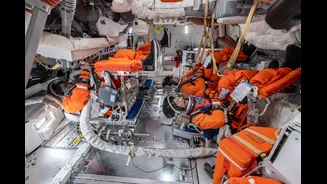
The Artemis II crew includes NASA astronauts Reid Wiseman, Victor Glover, Christina Koch, and Canadian astronaut Jeremy Hansen aboard the Orion spacecraft.
During the flyby, the spacecraft is set to surpass the record for the greatest distance from Earth ever achieved by a human mission, exceeding the milestone set by Apollo 13 in 1970. It is expected to break the record at 1:56 pm April 6 (11:26 pm IST, April 7) and reach its peak distance of 2,52,760 miles from Earth, compared to Apollo 13’s 2,48,655 miles.
The mission also includes scientific observations, spacecraft testing, and critical data collection for future lunar landings.
Here's what NASA chief said
NASA chief Jared Isaacman said that this is the first time astronauts are flying on the spacecraft, and collecting performance data remains a key priority. "I'd say we're focusing very much on the ecosystem, the life support system of the spacecraft. This is the first time astronauts have ever flown on this spacecraft before," Isaacman told CNN.
"That's what we're most interested in getting data from. That's what's going to help inform subsequent missions," he added.
Where to watch Artemis II Live
The Artemis II lunar flyby will be broadcast live on NASA’s official streaming service NASA+, as well as platforms like YouTube, Amazon Prime Video, Apple TV, Hulu, and others. Live coverage is scheduled to begin at 1 pm EDT (10:30 pm IST ) on April 6.
Viewers can also tune in to NASA’s official YouTube channel for continuous 24/7 mission updates.
Key Timings of the Lunar Flyby (IST)
Monday, April 6 (EDT) / Monday–Tuesday IST
- 12:41 am EDT (10:11 am IST): Orion enters the lunar sphere of influence at 41,072 miles from the Moon.
- 1:30 pm EDT (11 pm IST): The mission’s science officer briefs the crew on their goals for the flyby.
- 1:56 pm EDT (11:26 pm IST): The Artemis II crew is expected to surpass the record set by Apollo 13 (1970) for the farthest distance humans have travelled from Earth.
- 2:45 pm EDT, April 6 (12:15 am IST, April 7): Lunar observations begin.
- 6:44 p. EDT, April 6 (4:14 am IST, April 7): Temporary loss of communication as Orion passes behind the Moon.
- 6:45 pm EDT, April 6 (4:15 am IST, April 7): ‘Earthset’ — Earth disappears behind the Moon from Orion’s view.
- 7:02 pm EDT, April 6 (4:32 am IST, April 7): Closest approach to the Moon (4,070 miles above surface).
- 7:07 pm EDT, April 6 (4:37 am IST, April 7): Crew reaches maximum distance from Earth.
- 7:25 pm EDT, April 6 (4:55 am IST, April 7): ‘Earthrise’ — Earth reappears.
- 7:25 pm EDT, April 6 (4:55 am IST, April 7): Communication with Mission Control is re-established.
- 8:35–9:32 pm EDT, April 6 (6:05–7:02 am IST, April 7): Solar eclipse as seen from the spacecraft.
- 9:20 pm EDT (6:50 am IST, April 7): Lunar observations conclude.
Tuesday, April 7 (EDT) / Tuesday IST
- 1:25 pm EDT (10:55 pm IST): Orion exits the lunar sphere of influence at 41,072 miles from the Moon.
Crew and mission highlights
The Artemis II crew includes NASA astronauts Reid Wiseman, Victor Glover, Christina Koch, and Canadian astronaut Jeremy Hansen aboard the Orion spacecraft.
During the flyby, the spacecraft is set to surpass the record for the greatest distance from Earth ever achieved by a human mission, exceeding the milestone set by Apollo 13 in 1970. It is expected to break the record at 1:56 pm April 6 (11:26 pm IST, April 7) and reach its peak distance of 2,52,760 miles from Earth, compared to Apollo 13’s 2,48,655 miles.
The mission also includes scientific observations, spacecraft testing, and critical data collection for future lunar landings.
Here's what NASA chief said
NASA chief Jared Isaacman said that this is the first time astronauts are flying on the spacecraft, and collecting performance data remains a key priority. "I'd say we're focusing very much on the ecosystem, the life support system of the spacecraft. This is the first time astronauts have ever flown on this spacecraft before," Isaacman told CNN.
"That's what we're most interested in getting data from. That's what's going to help inform subsequent missions," he added.