






What is the story about?
A star system, normally too faint to see without a telescope, is expected to flare up and become visible to the naked eye in 2026. Astronomers are monitoring T Coronae Borealis, often referred to as the ‘Blaze Star,’ a binary system that has experienced eruptions before and is considered due for another outburst.
Researchers say the most likely window falls around June 25, 2026, based on statistical modelling discussed in Research Notes of the American Astronomical Society.
A paper by Jean Schneider of the Paris Observatory pointed to that date as a strong candidate. If it happens, the timing would place the host constellation high in the night sky for observers in the Northern Hemisphere.
ALSO READ | NASA's AI foray: Perseverance Mars rover becomes first to complete space exploration without human guidance
What is this once in a generation celestial event
Despite the wording, the star does not blow itself apart. The system contains a red giant and a white dwarf locked in orbit. Gas from the larger star slowly falls onto the dense white dwarf, building pressure. Then a surface thermonuclear flash occurs. Astronomers classify this as a recurrent nova, not a supernova.
Distance matters here. The system sits roughly 3,000 light-years from Earth, in the small northern constellation Corona Borealis, sometimes called the Northern Crown.
ALSO READ | Potentially habitable planet found 146 light-years away, but with -70C temperatures
How bright the event will appear from Earth
Normally, the system sits near magnitude +10, well beyond naked-eye visibility. During an outburst, it could jump to about magnitude +2, similar in brightness to Polaris. That makes it noticeable, though not dominant in the sky. The bright phase is expected to last only days or weeks before fading again, per Forbes.
Where to look for Corona Borealis
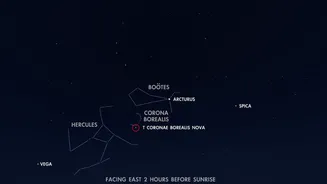
Corona Borealis lies between Boötes and Hercules. Skywatchers often trace an arc from the Big Dipper’s handle to bright Arcturus, then shift their gaze toward Vega. Roughly midway sits a faint semicircle of stars - that is, Corona Borealis.
ALSO READ | Snow Moon 2026: When and where to watch it on February 1
Why astronomers are watching this celestial event
The last confirmed eruptions occurred in 1866 and 1946. For observers, the outburst will offer both a visual spectacle and valuable observational data for astronomers tracking how such binary systems behave over time.
Researchers say the most likely window falls around June 25, 2026, based on statistical modelling discussed in Research Notes of the American Astronomical Society.
A paper by Jean Schneider of the Paris Observatory pointed to that date as a strong candidate. If it happens, the timing would place the host constellation high in the night sky for observers in the Northern Hemisphere.
ALSO READ | NASA's AI foray: Perseverance Mars rover becomes first to complete space exploration without human guidance
What is this once in a generation celestial event
Despite the wording, the star does not blow itself apart. The system contains a red giant and a white dwarf locked in orbit. Gas from the larger star slowly falls onto the dense white dwarf, building pressure. Then a surface thermonuclear flash occurs. Astronomers classify this as a recurrent nova, not a supernova.
Distance matters here. The system sits roughly 3,000 light-years from Earth, in the small northern constellation Corona Borealis, sometimes called the Northern Crown.
ALSO READ | Potentially habitable planet found 146 light-years away, but with -70C temperatures
How bright the event will appear from Earth
Normally, the system sits near magnitude +10, well beyond naked-eye visibility. During an outburst, it could jump to about magnitude +2, similar in brightness to Polaris. That makes it noticeable, though not dominant in the sky. The bright phase is expected to last only days or weeks before fading again, per Forbes.
Where to look for Corona Borealis
Corona Borealis lies between Boötes and Hercules. Skywatchers often trace an arc from the Big Dipper’s handle to bright Arcturus, then shift their gaze toward Vega. Roughly midway sits a faint semicircle of stars - that is, Corona Borealis.
ALSO READ | Snow Moon 2026: When and where to watch it on February 1
Why astronomers are watching this celestial event
The last confirmed eruptions occurred in 1866 and 1946. For observers, the outburst will offer both a visual spectacle and valuable observational data for astronomers tracking how such binary systems behave over time.