
The out-and-back journey may begin as early as February 6.
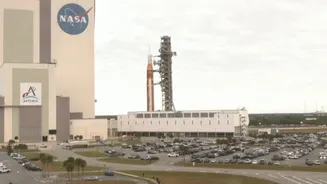
The 98-metre rocket started its 1 mph (1.6 km/h) crawl from the vehicle assembly building at Kennedy Space Centre at dawn. It took till dusk to complete the four-mile walk.
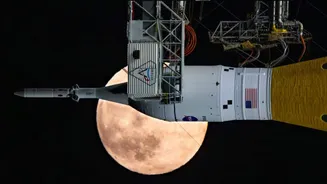
The Space Launch System (SLS) rocket and its associated Orion crew capsule were carefully removed from the Vehicle Assembly Building on Saturday and transported approximately four miles to Launch Pad 39B. The rocket, which was 322 feet tall and weighed almost 11 million pounds, travelled on a huge crawler-transporter at walking speed, or a little more than one mile per hour.
Thousands of NASA employees, their families, and space enthusiasts gathered in the predawn frost to witness the ceremony-like procession – a milestone year in the making following several delays in theArtemis program.
NASA’s giant new moon rocket moved to the launch pad in preparation for astronauts’ first lunar fly-around in more than half a century. The out-and-back
trip could blast off as early as February. pic.twitter.com/IpWjHBnUdD
— The Associated Press (@AP) January 18, 2026
A large transporter utilised during the Apollo and shuttle periods carried the rocket and Orion crew capsule, weighing a combined 5 m kg. It was modified to accommodate the additional weight of the SLS rocket.
An empty Orion capsule was launched into orbit around the moon in the first and only other SLS mission in November 2022.
The rocket will be used for NASA's first crewed voyage outside of Earth's orbit since Apollo 17 in 1972, the Artemis II mission. Four astronauts, Reid Wiseman (commander), Victor Glover (pilot), Christina Koch, and Jeremy Hansen of Canada, will go around the Moon for around 10 days before returning to Earth. They will not orbit or land on the lunar surface, according to the Associated Press.
“This one feels a lot different, putting crew on the rocket and taking the crew around the moon,” NASA’s John Honeycutt told the AP News.
They will be the first humans to go to the moon since Harrison Schmitt and Gene Cernan of Apollo 17 completed the successful lunar landing program in 1972. Neil Armstrong and Buzz Aldrin were the first two of 12 astronauts to walk on the moon in 1969.
Engineers will start a number of last-minute preparations, such as testing and system checks, as soon as they get at the pad. The "wet dress rehearsal," a complete fuelling and countdown simulation that is now set for early February, will be an important milestone.
NASA will not declare an official launch date until these tests are successfully completed.