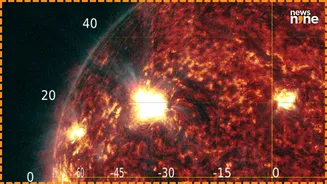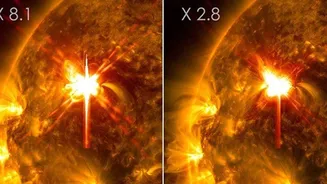

The events were logged by NASA, with imagery captured by the Solar Dynamics Observatory, which monitors the Sun continuously.
Scientists track four major solar flares in two days
Threestrong flares were recorded on February 1, with peak times at 7:33 am, 6:37 pm, and 7:36 pm Eastern Time. Another followed at 3:14 am ET on February 2.
What are X-class flares
All four were classified as X-class flares - the highest category used by space weather scientists. The most powerful reached X8.1, while the others measured X1.0, X2.8, and X1.6.
X-class flares can interfere with radio signals, satellite operations, navigation systems, and, in extreme cases, power infrastructure. They also increase radiation exposure risks for astronauts in orbit.
Activity traced to one region of the Sun
Scientists linked the eruptions to sunspot region AR 4366, described by monitoring groups as unusually active. Within roughly a day, the region produced dozens of smaller flares along with the larger bursts.
Sunspots are areas of concentrated magnetic energy. When that energy shifts or reconnects, flares can occur. Space weather trackers referred to AR 4366 as a ‘solar flare factory’ because of how quickly events followed one another.
Why auroras may intensify in the coming days
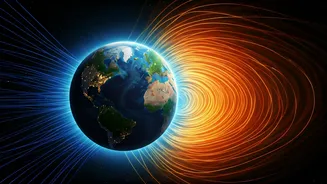
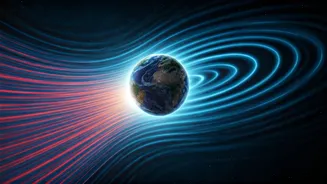
Large flares are often associated with coronal mass ejections (CMEs) - clouds of charged particles moving through space. If a CME is directed toward Earth, it can disturb the planet’s magnetic field and trigger geomagnetic storms.
Preliminary modelling from US forecasters suggests at least one CME linked to this activity could pass near Earth in the coming days. The exact impact is still uncertain.
Solar scientists note that the Sun is in an active phase of its cycle, meaning further eruptions are possible. Monitoring remains ongoing.