







What is the story about?
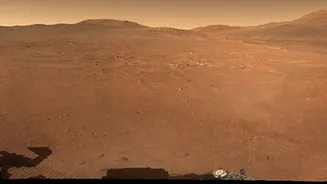
NASA’s Perseverance Rover has released a stunning 360-degree panoramic view of a region on Mars nicknamed ‘Crocodile Bridge’ that offers scientists a rare look at some of the oldest geological formations in the solar system.
According to NASA, the panorama was captured using the rover’s Mastcam-Z camera system from the rim of Jezero Crater.
The space agency has described Jezero Crater as the location that “shows promising signs of being a place that was likely friendly to life in the distant past.”
NASA said the image is made up of 980 photographs stitched together to create a detailed natural-colour landscape that shows the terrain as it would appear to the human eye.
Of them, 971 images were captured on December 18 last year during the rover’s 1,717th Martian day, or Sol, on the Red Planet. The remaining nine images were taken later on January 25, 2026, during Sol 1,754 of the mission.
NASA said the Jezero Crater rim and surrounding regions are believed to contain some of the “oldest rocks found anywhere in the solar system.” Scientists consider these formations crucial because they preserve evidence from the earliest stages of Mars’ history when the planet’s crust and atmosphere were still forming billions of years ago.
The agency explained that no terrain this ancient survives on Earth because tectonic plates “constantly recycle the planet’s surface.” Mars does not have tectonic plates, which allows extremely old geological material to remain preserved for billions of years.
What is the Crocodile Bridge?
Crocodile Bridge is located at an important transition point between the floor of Jezero Crater and its rim. Scientists believe the rocks in this area date back to the Noachian period, more than 3.7 billion years ago. This period existed before water is believed to have filled Jezero Crater and even before the impact event that formed the crater itself.
The feature is rugged, arch-shaped rock formation that resembles the back of a crocodile, which led to the nickname ‘Crocodile Bridge.’ Researchers believe the area could provide important insights into the
environmental conditions that existed on ancient Mars.
The space agency also said the region marks the entrance to another scientifically important area nicknamed ‘Lac de Charmes’, where Perseverance is expected to continue exploration for several months later this year.
Perseverance is managed by NASA’s Jet Propulsion Laboratory and operates as part of the Mars 2020 mission under NASA’s Mars Exploration Programme.
According to NASA, the panorama was captured using the rover’s Mastcam-Z camera system from the rim of Jezero Crater.
The space agency has described Jezero Crater as the location that “shows promising signs of being a place that was likely friendly to life in the distant past.”
NASA said the image is made up of 980 photographs stitched together to create a detailed natural-colour landscape that shows the terrain as it would appear to the human eye.
Of them, 971 images were captured on December 18 last year during the rover’s 1,717th Martian day, or Sol, on the Red Planet. The remaining nine images were taken later on January 25, 2026, during Sol 1,754 of the mission.
NASA said the Jezero Crater rim and surrounding regions are believed to contain some of the “oldest rocks found anywhere in the solar system.” Scientists consider these formations crucial because they preserve evidence from the earliest stages of Mars’ history when the planet’s crust and atmosphere were still forming billions of years ago.
The agency explained that no terrain this ancient survives on Earth because tectonic plates “constantly recycle the planet’s surface.” Mars does not have tectonic plates, which allows extremely old geological material to remain preserved for billions of years.
What is the Crocodile Bridge?
Crocodile Bridge is located at an important transition point between the floor of Jezero Crater and its rim. Scientists believe the rocks in this area date back to the Noachian period, more than 3.7 billion years ago. This period existed before water is believed to have filled Jezero Crater and even before the impact event that formed the crater itself.
The feature is rugged, arch-shaped rock formation that resembles the back of a crocodile, which led to the nickname ‘Crocodile Bridge.’ Researchers believe the area could provide important insights into the
The space agency also said the region marks the entrance to another scientifically important area nicknamed ‘Lac de Charmes’, where Perseverance is expected to continue exploration for several months later this year.
Perseverance is managed by NASA’s Jet Propulsion Laboratory and operates as part of the Mars 2020 mission under NASA’s Mars Exploration Programme.