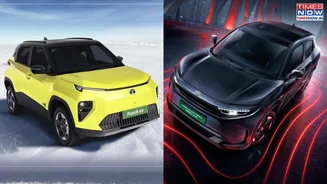






Tata Motors CEO on EV segment, sectoral challenges & more: Tata Motors Passenger Vehicles Ltd’s MD and CEO Shailesh Chandra has said that the recent changes
in goods and services tax (GST) have further pushed the price parity out of reach for entry-level electric vehicles. Chandra said that the EV sector is currently reeling under structural cost challenges and unless the Centre extends aid to e-cars priced below Rs 10 lakh it will become difficult scaling electric cars into mass-market adoption, according to an Economic Times report. “If EVs have to go mainstream, this is the segment that must click," Chandra said, adding that in small cars, battery costs can account for nearly 70% of the vehicle price while customers still expect a real-world range of over 400 km. More than half of India's car buyers are below the Rs 10 lakh mark, a sector where the Tata Group automotive flagship sells the Tiago and Tigor electric cars. “From an environmental return-on-investment perspective, this is where government support delivers the biggest impact,” said Chandra. Prior to the PM E-DRIVE scheme which took effect from October 2024, e-cars in the fleet segment were getting subsidies of Rs 10,000 per kWh, capped at Rs 1.5 lakh. According to Chandra, the year had "two unequal halves", with the first eight months under pressure till the GST cuts, which took effect on September 22, and demand improving sharply from November onwards. India’s automobile industry extended its growth momentum in December 2025, with sales across all major sectors posting strong year-on-year gains, according to data released by the Society of Indian Automobile Manufacturers (SIAM). Domestic passenger vehicle sales stood at 3,99,216 units in December 2025, compared with 3,14,934 units in the year-ago period, marking a growth of 26.8 percent. Two-wheeler dispatches increased 39 per cent year-on-year to 15,41,036 units in December, up from 11,05,565 units in the same month last year. Three-wheeler sales rose 17 per cent to 61,924 units, compared with 52,733 units in December 2024. Meanwhile, the Ministry of Heavy Industries has notified partial modifications to the production linked incentive (PLI) scheme for the automobile and auto component industry, tightening electric vehicle (EV) eligibility norms and aligning incentives with PM E-DRIVE, effective January 13, 2026, the Economic Times reported. The government has notified that for the new EV eligibility, only battery electric vehicles meeting revised performance norms will qualify for the incentives. The scheme will now be aligned with PM E-DRIVE for battery electric 2W, 3W and e-buses and trucks.