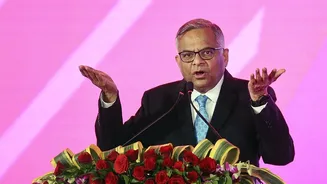







Tata Group chairman N Chandrasekaran said the conglomerate is entering a phase of “big strategic opportunities” despite global uncertainty, betting heavily
on advanced manufacturing, artificial intelligence and sustainability to drive its next phase of growth.
In his New Year message to employees, Chandrasekaran described 2025 as a “humbling year, unrelenting in its unpredictability,” marked by geopolitical tensions, rapid technological change and operational challenges. Still, he said global growth proved more resilient than expected, aided by fiscal expansion in Europe, stronger-than-anticipated growth in China and easing inflation that led to softer financial conditions.
India’s economy, he noted, continued to outperform, reinforcing its trajectory to become the world’s third-largest economy this decade.
For the Tata Group, Chandrasekaran said the current era of realignments could set the stage for “the most successful” period in its long history. He highlighted major strides in manufacturing, including new precision facilities for iPhone production and final assembly of C-295 defence aircraft. Of the group’s manufacturing footprint, 10 factories are new builds, with six more under construction — including a semiconductor fabrication plant in Dholera and gigafactories in Sanand, Gujarat, and Somerset in the UK.
“All of our new factories are designed to be AI-first,” he said, adding that this should translate into higher quality and productivity.
Sustainability remained a central theme. Tata Motors crossed a milestone of 250,000 electric vehicles on Indian roads, accounting for 66% of the country’s EV fleet, while Tata Steel is set to begin producing green steel in India in the coming year.
Among other milestones, Chandrasekaran cited Tata Motors Commercial Vehicles’ acquisition of Iveco — the group’s largest to date — which positions it among the world’s top four CV players. Tata Capital completed a successful public listing, Trent crossed 1,000 stores, and Indian Hotels surpassed 600 sites.
Against what he called an “unprecedented global tech acceleration,” the group announced large investments in artificial intelligence, including a planned 1 GW AI data centre. TCS is repositioning itself to become the world’s largest AI-led technology services company, while the group is also investing in India- and industry-specific AI data models.
Chandrasekaran outlined five pillars for building an AI-driven organisation: fostering an AI-led culture, redefining a “bridgital” human-plus-AI work model, creating future-ready talent, developing tailored data and AI infrastructure, and deepening collaborations and partnerships.
At the same time, he warned of rising vulnerabilities. A cybersecurity attack on Jaguar Land Rover during the year underscored the need to prioritise resilience alongside growth. “The question is not simply whether shocks will happen, it is also about how well we can recover from shocks,” he said.
Looking ahead to 2026, Chandrasekaran urged Tata companies to focus on three priorities: disciplined execution, deeper teamwork and a willingness to take bold risks. He argued that in volatile times, half-measures rarely succeed and that sustained investment in research and scholarship is critical, even when returns take time.
He pointed to the Tata Transformation Prize, awarded this year to Indian scientists working on projects ranging from genetically engineered rice and nanorobot-based cancer treatments to engineered bacteria for safer chemicals, as evidence that unlocking next-generation talent is key to India’s future.
Ending on a personal note, Chandrasekaran shared stories from Tata Group’s CSR initiatives — from a grandmother in cyclone-hit Odisha who now runs her own flower shop after joining a literacy programme, to young women building AI-driven agri-startups and pursuing advanced scientific research abroad.
“These are the stories that fill us with hope and energy for the future,” he said, thanking employees for their efforts and wishing them and their families health and happiness in 2026.