





What is the story about?
India is expected to roll out three components of the Export Promotion Mission (EPM) this week, with landlocked states set to receive focused export-boosting support. Highlighting that while the Finance Ministry’s package aims to provide export credit and moratoriums to exporters, the Commerce Ministry said that, apart from the EPM, it is working on issues like market access and interest subvention to alleviate exporters' problems.
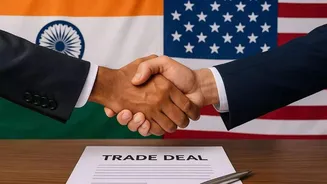
Stating that exporters to the United States have held ground despite 50% tariffs on labour-intensive goods, which is around 30% higher than competitors, the Commerce Ministry said that there is an expectation on both sides that a trade deal could be worked out to address the issue of tariffs.
Pointing out the pressure on textile exporters due to the large size of the US market, the Commerce Ministry added that some amount of export diversification has taken place, noting that any US-targeted support would be ineffective due to tariffs.
However, it noted that despite one-third of marine exports being dependent on the US, a rise has been observed in overall exports of the commodity in the first eight months of the fiscal year (FY) due to increased shipments to the European Union (EU) and the Association of Southeast Asian Nations (ASEAN) bloc.
On 12th November, the Union Cabinet had approved the EPM to strengthen India’s export competitiveness, particularly for micro, small, and medium enterprises (MSMEs), first-time exporters, and labour-intensive sectors.
The Mission aims to provide a comprehensive, flexible, and digitally driven framework for export promotion, with a total outlay of ₹25,060 crore for FY 2025–26 to FY 2030–31. The government described the initiative as a strategic shift from multiple fragmented schemes to a single, outcome-based, and adaptive mechanism capable of responding swiftly to global trade challenges and evolving exporter needs.
The scheme is part of a collaborative framework between the Department of Commerce, Ministry of MSME, Ministry of Finance, and other stakeholders, including financial institutions, Export Promotion Councils, Commodity Boards, industry associations, and state governments.
Also read: Commerce Secretary: India, US close to a framework deal, won't give a timeline
The announcement confirmed CNBC-TV18's newsbreak from August 2025, which had indicated details about the then-proposed scheme. Answering a question on whether the government had considered the India-US bilateral trade agreement (BTA) talks before approving the export package, Union Minister Ashwini Vaishnaw said that all factors were taken into account.
The Mission will operate through two integrated sub-schemes:
NIRYAT PROTSAHAN: Focuses on improving access to affordable trade finance for MSMEs through instruments such as interest subvention, export factoring, collateral guarantees, credit cards for e-commerce exporters, and credit enhancement support for diversification into new markets.
NIRYAT DISHA: Focuses on non-financial enablers that enhance market readiness and competitiveness, including export quality and compliance support, assistance for international branding, packaging, participation in trade fairs, export warehousing and logistics, inland transport reimbursements, and trade intelligence and capacity-building initiatives.
The EPM has consolidated key export support schemes such as the Interest Equalisation Scheme (IES) and Market Access Initiative (MAI) by aligning them with contemporary trade needs. It aims to directly address structural challenges that constrain Indian exports, including:
Priority support will be extended to sectors impacted by recent global tariff escalations, such as textiles, leather, gems and jewellery, engineering goods, and marine products, to help sustain export orders, protect jobs, and support diversification into new geographies.
The Directorate General of Foreign Trade (DGFT) will act as the implementing agency, with all processes—from application to disbursal—being managed through a dedicated digital platform integrated with existing trade systems.
According to the government, the Mission is expected to:
Stating that exporters to the United States have held ground despite 50% tariffs on labour-intensive goods, which is around 30% higher than competitors, the Commerce Ministry said that there is an expectation on both sides that a trade deal could be worked out to address the issue of tariffs.
Pointing out the pressure on textile exporters due to the large size of the US market, the Commerce Ministry added that some amount of export diversification has taken place, noting that any US-targeted support would be ineffective due to tariffs.
However, it noted that despite one-third of marine exports being dependent on the US, a rise has been observed in overall exports of the commodity in the first eight months of the fiscal year (FY) due to increased shipments to the European Union (EU) and the Association of Southeast Asian Nations (ASEAN) bloc.
On 12th November, the Union Cabinet had approved the EPM to strengthen India’s export competitiveness, particularly for micro, small, and medium enterprises (MSMEs), first-time exporters, and labour-intensive sectors.
The Mission aims to provide a comprehensive, flexible, and digitally driven framework for export promotion, with a total outlay of ₹25,060 crore for FY 2025–26 to FY 2030–31. The government described the initiative as a strategic shift from multiple fragmented schemes to a single, outcome-based, and adaptive mechanism capable of responding swiftly to global trade challenges and evolving exporter needs.
The scheme is part of a collaborative framework between the Department of Commerce, Ministry of MSME, Ministry of Finance, and other stakeholders, including financial institutions, Export Promotion Councils, Commodity Boards, industry associations, and state governments.
Also read: Commerce Secretary: India, US close to a framework deal, won't give a timeline
The announcement confirmed CNBC-TV18's newsbreak from August 2025, which had indicated details about the then-proposed scheme. Answering a question on whether the government had considered the India-US bilateral trade agreement (BTA) talks before approving the export package, Union Minister Ashwini Vaishnaw said that all factors were taken into account.
The Mission will operate through two integrated sub-schemes:
NIRYAT PROTSAHAN: Focuses on improving access to affordable trade finance for MSMEs through instruments such as interest subvention, export factoring, collateral guarantees, credit cards for e-commerce exporters, and credit enhancement support for diversification into new markets.
NIRYAT DISHA: Focuses on non-financial enablers that enhance market readiness and competitiveness, including export quality and compliance support, assistance for international branding, packaging, participation in trade fairs, export warehousing and logistics, inland transport reimbursements, and trade intelligence and capacity-building initiatives.
The EPM has consolidated key export support schemes such as the Interest Equalisation Scheme (IES) and Market Access Initiative (MAI) by aligning them with contemporary trade needs. It aims to directly address structural challenges that constrain Indian exports, including:
- Limited and expensive trade finance access
- High cost of compliance with international export standards
- Inadequate export branding and fragmented market access
- Logistical disadvantages for exporters in interior and low-export-intensity regions
Priority support will be extended to sectors impacted by recent global tariff escalations, such as textiles, leather, gems and jewellery, engineering goods, and marine products, to help sustain export orders, protect jobs, and support diversification into new geographies.
The Directorate General of Foreign Trade (DGFT) will act as the implementing agency, with all processes—from application to disbursal—being managed through a dedicated digital platform integrated with existing trade systems.
According to the government, the Mission is expected to:
- Facilitate access to affordable trade finance for MSMEs
- Enhance export readiness through compliance and certification support
- Improve market access and visibility for Indian products
- Boost exports from non-traditional districts and sectors
- Generate employment across manufacturing, logistics, and allied services