







What is the story about?
Nvidia Corp. is entering the PC industry to modernise computers for the AI future and end Intel Corp.'s technological hegemony. The company will be deploying a new processor as it ventures into this new space.
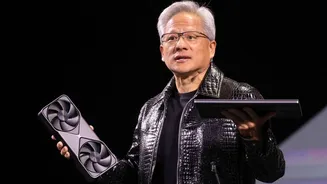
Jensen Huang stated at the Computex trade event in Taipei that Nvidia's new RTX Spark Superchip will make its debut in laptop and desktop computers from key PC manufacturers, including Dell Technologies and Lenovo Group Ltd., starting this autumn. Built with assistance from Taiwan's MediaTek Inc., the product combines a microprocessor and graphics chip to run Microsoft's Windows for ARM operating system.
After participating in an initiative that failed more than ten years ago, Nvidia, now a major force in data centres, is making another attempt at the personal computer processor market.
The endeavour also strengthens Nvidia's attempts to maintain its pivotal position at the centre of all AI research and application.
Also Read: May Auto Sales: Escorts Kubota shares decline despite 19% growth; Here are the near-term headwinds
The first new laptops made with RTX Spark, according to the Santa Clara, California-based business, would target the luxury market and be designed to get rid of the competitors' constraints. Because of the chip's efficiency, PC manufacturers will be able to provide incredibly powerful devices that are nonetheless lightweight and tiny.
However, the revenue generated by its data centre chip range currently exceeds the total sales of its closest competitors. In its most recent quarter, Nvidia's revenues were about the same as those of Advanced Micro Devices Inc. and Intel last year.
Nonetheless, investors who have raised their bids on Nvidia's stock due to the rapid development of AI could be pleased to see Nvidia expanding its line of devices that will provide end consumers with the technology. Nvidia's stock has underperformed the benchmark Philadelphia Stock Exchange Semiconductor Index this year while reporting growth that surpasses that of other chipmakers.
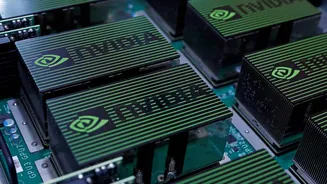
The RTX Superchip will have a Blackwell-generation graphics processor with 6,144 cores and a central processing unit with up to 20 computational cores. Large AI models and expensive games will be easier for the two components to handle because they will share built-in memory. They will communicate using Nvidia's NVLink interface, introducing a portion of data centre technology to home computers. TSMC will produce the chip design.
According to Nvidia, it has collaborated with Microsoft for years to develop the new gadgets and guarantee software support that will enable Arm Holdings Plc technology to ultimately become widely used in the Windows PC industry. For over a year, Qualcomm and Microsoft have jointly marketed comparable PCs, albeit with little success.
The majority of PCs, aside from Apple Inc.'s Mac series, are powered by AMD or Intel processors. Arm outperforms those competitors in terms of power efficiency, but it lags behind in terms of software compatibility.
AI models and features in widely used applications will be easier for the new Nvidia-based hardware to handle. For instance, Photoshop from Adobe Inc. is being redesigned to better generate image and video output in response to AI-based cues. According to Nvidia, the new gadgets will also improve gaming capabilities, enabling laptops to run top-tier games.
Large AI models can typically be safely operated on Nvidia-based PCs, providing users with simply implementable controls over what software and data are accessed.
The development of PCs becoming personal assistants that do more than just react to human input will be accelerated by such protections. According to Nvidia, routine operations like email searches and more complicated ones like finding and correcting website faults would become a lot simpler.
Based on competing technologies, the corporation refused to provide performance comparisons between planned and current devices. When the new devices are prepared for sale, that information will be made available, according to Nvidia. The company does not anticipate that availability will be impacted by the present semiconductor industry component supply limitations.
Jensen Huang stated at the Computex trade event in Taipei that Nvidia's new RTX Spark Superchip will make its debut in laptop and desktop computers from key PC manufacturers, including Dell Technologies and Lenovo Group Ltd., starting this autumn. Built with assistance from Taiwan's MediaTek Inc., the product combines a microprocessor and graphics chip to run Microsoft's Windows for ARM operating system.
After participating in an initiative that failed more than ten years ago, Nvidia, now a major force in data centres, is making another attempt at the personal computer processor market.
The endeavour also strengthens Nvidia's attempts to maintain its pivotal position at the centre of all AI research and application.
Also Read: May Auto Sales: Escorts Kubota shares decline despite 19% growth; Here are the near-term headwinds
The first new laptops made with RTX Spark, according to the Santa Clara, California-based business, would target the luxury market and be designed to get rid of the competitors' constraints. Because of the chip's efficiency, PC manufacturers will be able to provide incredibly powerful devices that are nonetheless lightweight and tiny.
However, the revenue generated by its data centre chip range currently exceeds the total sales of its closest competitors. In its most recent quarter, Nvidia's revenues were about the same as those of Advanced Micro Devices Inc. and Intel last year.
Nonetheless, investors who have raised their bids on Nvidia's stock due to the rapid development of AI could be pleased to see Nvidia expanding its line of devices that will provide end consumers with the technology. Nvidia's stock has underperformed the benchmark Philadelphia Stock Exchange Semiconductor Index this year while reporting growth that surpasses that of other chipmakers.
The RTX Superchip will have a Blackwell-generation graphics processor with 6,144 cores and a central processing unit with up to 20 computational cores. Large AI models and expensive games will be easier for the two components to handle because they will share built-in memory. They will communicate using Nvidia's NVLink interface, introducing a portion of data centre technology to home computers. TSMC will produce the chip design.
According to Nvidia, it has collaborated with Microsoft for years to develop the new gadgets and guarantee software support that will enable Arm Holdings Plc technology to ultimately become widely used in the Windows PC industry. For over a year, Qualcomm and Microsoft have jointly marketed comparable PCs, albeit with little success.
The majority of PCs, aside from Apple Inc.'s Mac series, are powered by AMD or Intel processors. Arm outperforms those competitors in terms of power efficiency, but it lags behind in terms of software compatibility.
AI models and features in widely used applications will be easier for the new Nvidia-based hardware to handle. For instance, Photoshop from Adobe Inc. is being redesigned to better generate image and video output in response to AI-based cues. According to Nvidia, the new gadgets will also improve gaming capabilities, enabling laptops to run top-tier games.
Large AI models can typically be safely operated on Nvidia-based PCs, providing users with simply implementable controls over what software and data are accessed.
The development of PCs becoming personal assistants that do more than just react to human input will be accelerated by such protections. According to Nvidia, routine operations like email searches and more complicated ones like finding and correcting website faults would become a lot simpler.
Based on competing technologies, the corporation refused to provide performance comparisons between planned and current devices. When the new devices are prepared for sale, that information will be made available, according to Nvidia. The company does not anticipate that availability will be impacted by the present semiconductor industry component supply limitations.