





Boats can be as similar and as different as automobiles and other vehicles. For example, boats have different engine types and mechanical systems, which include specific battery configurations. Some boats use two batteries instead of one. The reason for that has to do with the power demand being placed on the boat's systems and the power it takes to get things moving.
One battery is used to initially start the engine. This battery only requires enough power for that single task, and it delivers that power in a short
surge. Depending on the vessel, a starting battery isn't designed to power the boat's other systems, which is why a second battery is needed. In fact, if the boat is over 15 feet in size, a single starting battery may not be enough to power it. But since this isn't the case for every boat, the second battery may not be a starting battery at all.
The second battery can be a deep-cycle battery, which is used to power different devices onboard. That can include lights and trolling motors, among others. It can power additional equipment as well, like GPS trackers and depth finders. A deep-cycle battery is an ideal solution for these systems, as it can deliver power longer than a starting battery can. But if a boat has more devices onboard that require additional total running power, more deep-cycle batteries may be needed.
Read more: Every Class Of Battleship The U.S. Navy Operated In WWI And WWII
Facts about the dual-battery system
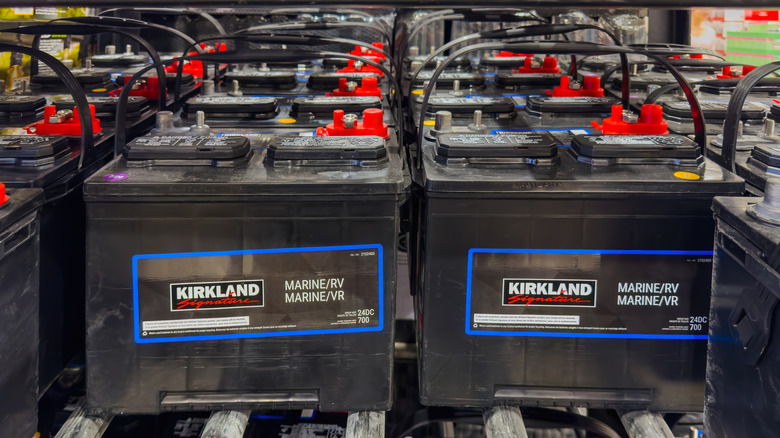
The advantages of using a dual-battery system on a boat come down to practicality. For the initial startup, the starting battery gets the job done without struggling and risking damage. For consistent power delivery, the deep-cycle battery does the heavy lifting, reliably powering the boat's onboard electrical systems. When these batteries are in good working condition and performing as designed, the end result can be a smoother and more efficient operation.
A starting battery and a deep-cycle battery will usually run in separate banks. However, before adding another battery to one of these banks, you must be sure to select the right kind. This means that your batteries must match in chemistry and type, because when the charging system is doing its work, both batteries must charge up to the same threshold. Otherwise, one battery may not have enough charge, while the other one could have too much.
However, that does not mean that all batteries used on a boat must match. For example, you can run a lead-acid starting battery with a lithium-ion deep-cycle battery. Additionally, the charging system for each battery must be compatible with the connected battery type. To learn more about battery compatibility for your specific model, consult your owner's manual.
Want the latest in tech and auto trends? Subscribe to our free newsletter for the latest headlines, expert guides, and how-to tips, one email at a time. You can also add us as a preferred search source on Google.
Read the original article on SlashGear.