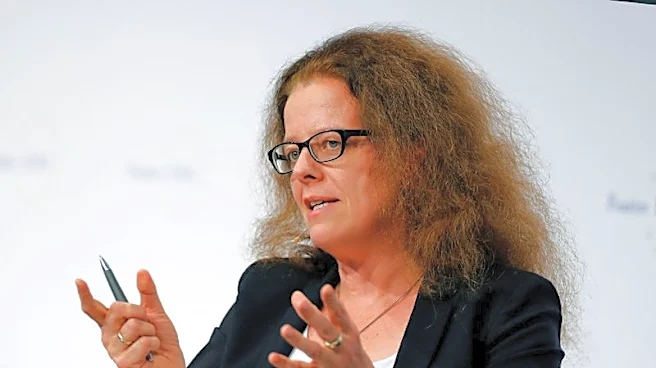

FRANKFURT, June 1 (Reuters) - The increased use of stablecoins could reinforce the dollar's global dominance, undermine some nations' ability to set monetary policy and even diminish the role of the euro,
European Central Bank board member Isabel Schnabel said on Monday.
The use of stablecoins, a type of cryptocurrency pegged to certain assets and designed to maintain a stable value, is still relatively low but has increased quickly and modelling by analysts has suggested a further rapid spread.
The vast majority of stablecoins are pegged to the U.S. dollar and a rapid growth in issuance could slow or even reverse a two-decades-long decline in the global role of the dollar, some economists say.
"The dollar’s dominance would be reinforced, not necessarily owing to stronger economic fundamentals but due to network effects, scale and first-mover advantages," Schnabel told a Bank of Korea conference in Seoul, with reference to the rise in use.
The share of the dollar in foreign exchange reserves fell to below 57% last year, down from 70% at the turn of the century, as smaller currencies have taken its market share, IMF data shows.
While a boost to the dollar from increased use of stablecoins could have the biggest impact on countries whose monetary policy lacks credibility, the implications, Schnabel said, could potentially affect the euro, too.
It could also be a vicious circle, as people may be more drawn to dollar-based stablecoins in countries lacking policy credibility, which could further weaken the central bank's ability to transmit policy change to the real economy.
"Even for regions with strong monetary credibility, the persistent dominance of U.S. dollar stablecoins could, over time, have undesirable consequences if it strengthens U.S. dollar invoicing and global liquidity holdings," Schnabel said.
"From a European perspective, this could eventually limit the euro's role in emerging forms of tokenised finance and in the international monetary system more generally."
(Reporting by Balazs Koranyi; editing by Barbara Lewis)