



By Will Dunham
WASHINGTON, Nov 20 (Reuters) - Astronomers have observed a large dying star, seven times more massive and 18,000 times brighter than the sun, engulfing a smaller companion in a stellar merger unlike any other previously witnessed.
The merger involved a pair of stars that were bound gravitationally — known as a binary system — in which the larger one greatly expanded in its death throes into what is called a puffy supergiant and enveloped the smaller one, with the two stars then combining
into one.
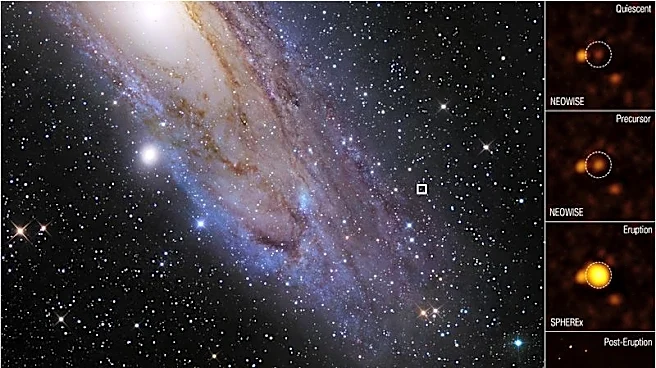
This cosmic connection occurred about 2.5 million light-years from Earth on the outskirts of the Andromeda Galaxy, one of our Milky Way's closest galactic neighbors. A light-year is the distance light travels in a year, 5.9 trillion miles (9.5 trillion km).
The researchers identified the impending engulfment nearly three years before it occurred and then watched as the merger unfolded, step by step.
"Giant stars engulfing their companion stars have been theorized for many decades, and understanding the outcomes of this process has important implications for explaining a wide range of systems that we see today in the universe," said Viraj Karambelkar, a postdoctoral researcher and NASA Hubble Fellow at Columbia University in New York, lead author of the research published in the journal Nature.
"The system presented in this study provides the first direct observations of this process happening — the first time a giant star engulfing its companion was caught in the act," Karambelkar said.
Large stars near the end of their lifespan can swell up as their cores run out of fuel and shrink while the inner stellar heat pushes the outer layers outward. The larger star in this study puffed up to 350 times the sun's diameter. The smaller star, whose diameter was about 70% that of the sun, orbited its companion at roughly the same distance as between Mars and the sun, and was engulfed in the bigger star's expansion.
'SET OFF A BOMB'
The researchers detected brightening when this occurred in 2018, and the smaller star began to spiral inward toward the core of the bigger star over the next seven years. Toward the end of 2025, the smaller star finally merged with the core of the larger one, triggering an eruption a million times brighter than the sun in what Karambelkar called "a unification event."
"This violent collision set off a bomb inside the star, producing the bright eruption that we saw," Karambelkar said.
The researchers first spotted the stars using data from the infrared WINTER telescope at Palomar Observatory in California and NASA's NEOWISE space telescope, then watched the events with the orbiting SPHEREx and James Webb space telescopes and various ground-based observatories.
"We have observed mergers of stars in the past," said Columbia astrophysics professor and study co-author Kishalay De.
"The difference is in the nature of the stars that merged. In the past, stellar mergers were observed from two stars that were fairly small and compact, and their merger was almost inevitable once they came into physical contact. However, the bigger star in this event was a very puffed-up star where its outer envelope was loosely bound. This configuration is exactly the kind in which a merger may or may not happen," De said.
In some cases, an engulfed smaller star might release enough energy to blow away the larger star's puffy outer layers, leaving behind the remaining core of the original bigger star orbiting the smaller one, De said.
While the larger of the two stars in this instance was nearing the end of its life, the merger may have produced a rejuvenated star with a new lease on life, the researchers said.
The researchers gave the merged star the nickname Bao, the name of popular steamed buns in Chinese cuisine.
"The auto-assigned name to this eruption was AT2025abao — 'Astronomical Transient in 2025 abao.' We called it Bao as an affectionate term derived from this. The similarity with the Chinese buns definitely encouraged us to adopt the nickname," Karambelkar said.
(Reporting by Will Dunham, Editing by Rosalba O'Brien)