



By Rocky Swift
TOKYO, Oct 8 (Reuters) - Japan's Fast Retailing, owner of global clothing brand Uniqlo, reported a forecast-beating 32% rise in annual profit on Thursday, driven by strong sales in North America and Europe, which overtook China as its largest market for the first time.
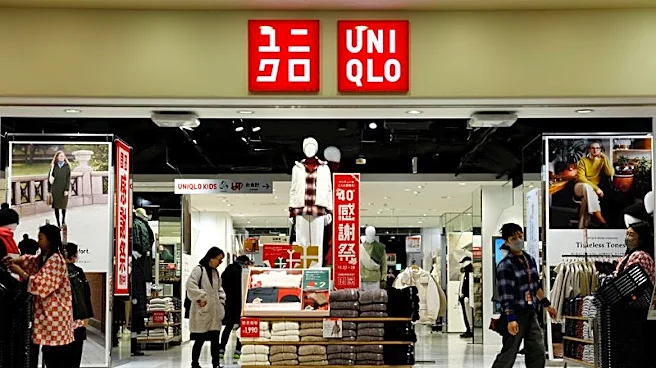
The shift marks a milestone for the retailer, which has relied on China as its largest overseas market for years, supported by nearly 900 Uniqlo stores.
Its push into newer markets in recent years has helped cushion the
impact of weakening sales in China, where a prolonged consumer spending slowdown and intensifying competition from domestic brands have pressured foreign companies across sectors ranging from autos to luxury goods and retail.
Company founder and president Tadashi Yanai on Thursday repeated a goal to reach annual sales of 10 trillion yen ($63.2 billion), from just under 4 trillion in the just-completed year, by adding about 500 billion yen each year.
"When you say 500 billion yen, in our clothing retail sector, that’s a massive company," Yanai said. "It’s roughly the equivalent of one such company being created every year," Yanai said.
"If you look around the world, there are regions everywhere with that sort of potential."
Yanai, Japan’s richest man, has long said he wants to make Fast Retailing the world’s top clothing retailer, putting the company in competition with Zara owner Inditex and Sweden's H&M.
Combined revenue from North America and Europe reached 877.6 billion yen, topping the 724 billion yen it earned from greater China.
Fast Retailing reported its fifth consecutive record annual operating profit, citing strong performances across all regions despite currency-related headwinds in Japan.
Operating profit came in at 743.13 billion yen ($4.70 billion) in the 12 months ended August 31, exceeding the company's own forecast of 730 billion yen and the 726.45 billion yen average estimate from 16 analysts polled by LSEG.
The company forecast operating profit to climb further still to 830 billion yen in the next fiscal year.
Management, however, warned that a weak yen was making conditions more difficult in Japan, where higher import costs were expected to weigh on fourth-quarter results and lead to price increases.
From one store in Hiroshima in 1984, the group has grown to more than 2,500 Uniqlo locations globally, selling inexpensive fleeces and basic goods made primarily in Asia.
Fast Retailing is widely seen as a bellwether for consumer sentiment in Japan and China. Store numbers have levelled off in both markets, reaching saturation levels in Japan while the company is shutting underperforming locations in China and replacing them with newer, larger shops to revive foot traffic.
With online retail eating into the business of standard Uniqlo outlets, Fast Retailing is focusing on large, multi-level stores.
The format has helped grow the brand in North America and Europe, and Fast Retailing is looking to double the number of so-called flagship stores in Japan to 20 in the next decade, Yanai told the Nikkei newspaper in August.
($1 = 158.2000 yen)
(Reporting by Rocky Swift in Tokyo; Editing by Sonali Paul, Miyoung Kim)