
By Iain Withers, Amy-Jo Crowley, Charlie Conchie and Valentina Za
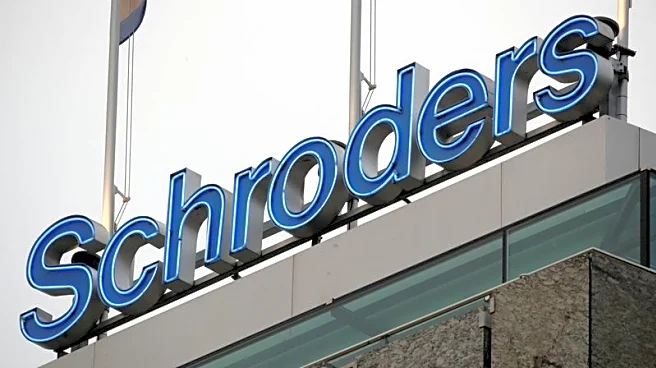
LONDON, Feb 13 (Reuters) - Historic British fund manager Schroders' decision this week to sell up to U.S. asset manager Nuveen highlights
the stark choice facing European rivals struggling to compete in a rapidly consolidating global industry: bulk up or sell out.
The Schroder founding family's around 42% holding in the company had always been seen as a stumbling block to a sale of the 222-year-old fund manager, but in the end they opted to cash out.
Stock-picking asset managers like Schroders have been structurally challenged by deeper-pocketed U.S. rivals selling low-cost passive products, a trend showing few signs of slowing, with the U.S. players now also expanding aggressively into higher-fee private markets.
Schroders' sale to Nuveen creates one of the world’s largest active fund managers running $2.5 trillion of assets, although it still trails the seven largest U.S. players - led by BlackRock and Vanguard - as well as France's Amundi.
“I would like to say this is parking a very large tank on everyone's lawn,” Richard Oldfield, CEO of Schroders, told Reuters after announcing the deal to sell the London finance house. “I'm not joking when (I say) I think this is a powerhouse.”
Company executives, analysts and bankers expect more deals to follow in Europe's fragmented asset management industry, where the region's 10 largest players account for just a quarter of the region's assets, according to Morningstar.
The U.S. fund management houses that have the financial firepower for takeovers are seen as the most likely suitors.
Independent players like Schroders, which expanded in an era of star fund managers, are seen as prime targets.
Morningstar analyst Johann Scholtz pointed to names such as London-listed Jupiter and Liontrust, alongside GAM, which he said are relatively cheap on a market value basis, as well as France's Comgest and Germany's Berenberg, another of Europe's historic finance houses which started life in Hamburg centuries ago.
An index of the biggest U.S. asset managers has gained 40% over the last five years, outperforming many European players like Amundi and Aberdeen, although some have turned a corner with the likes of DWS outperforming.
POTENTIAL DEALS CLOSER TO HOME
All-European merger deals are possible, especially when backed by bigger groups like banks. BNP Paribas last year bought AXA's fund arm.
But other transactions have been hard to execute and past examples of combinations, such as Aberdeen Asset Management and Standard Life, in Britain have struggled, with the shares down by about half since the 2017 deal.
Several courtships, including a planned tie-up last year between Italy's Generali and France's Natixis and early-stage talks between Amundi and Allianz Global Investors, have fallen through.
Consultancy Oliver Wyman expects deals for asset managers to accelerate further over the next four to five years, forecasting 1,500 mergers or acquisitions involving firms with at least 1 billion euros in assets, although it believes those combinations face challenges.
“Asset managers often command acquisition premiums, and cost savings are hard to realise in a people‑driven business, with the risk of losing talent or clients," Giambattista Taglioni, a partner at Oliver Wyman, said ahead of the Schroders announcement.
ANOTHER BLOW FOR LONDON'S FINANCIAL HUB
The sale of one of the City of London's best known names has put the spotlight again on the growing number of companies deserting London for other financial centres.
Sale talks accelerated in the past few weeks, with Schroders notifying the British government ahead of its announcement, Oldfield said.
The combined group would be better-placed to invest in Britain, he said, rejecting the notion it was another blow for the City of London, although it will result in another company exiting the FTSE 100 index following a foreign takeover.
Informal talks between Oldfield and Nuveen’s CEO Bill Huffman about the wider challenges in the industry began over several months late last year, before they realised a deal would be attractive to both companies. Nuveen put forward its offer in January, the two executives said in an interview.
Schroders was keen to assure the government the combined group would remain committed to the UK, two sources familiar with the matter told Reuters, declining to be named.
The board and the family realised a strong U.S. footprint was crucial to the company's long-term survival, one of the sources said, adding that Nuveen's commitment to the UK was central to winning the family's support.
The Schroder founding family – which still has two seats on the board and was advised by investment bank Lazard – have agreed to sell their 42% stake as part of the deal.
Schroders’ Oldfield said they were not given the choice to retain a stake by Nuveen.
Oldfield said some ties would remain, with the Schroders name retained for now and one family member still working in the London office.
"The (staff) café is named after Bruno," he added, referring to the great-great grandson of the company's co-founder, who died in 2019.
($1 = 0.8433 euros)
(Reporting by Iain Withers, Amy-Jo Crowley and Charlie Conchie, additional reporting by Valentina Za in Milan and Samuel Indyk in London; Editing by Tommy Reggiori Wilkes and Jane Merriman)