






By Joanna Plucinska and Shivansh Tiwary
FARNBOROUGH, England, July 23 (Reuters) - Chinese titanium suppliers used the Farnborough Airshow this week to court aerospace customers, betting tight global supplies of the critical metal would outweigh concerns over U.S. tariffs.
Titanium is essential to aircraft manufacturing because of its strength, light weight and corrosion resistance, making it a key material for jet engines, landing gear and airframes.
But supplies have been strained by a series of shocks
in recent years, from the COVID-19 pandemic and Western sanctions on major producer Russia following its 2022 full-scale invasion of Ukraine to U.S. tariffs on Chinese imports under President
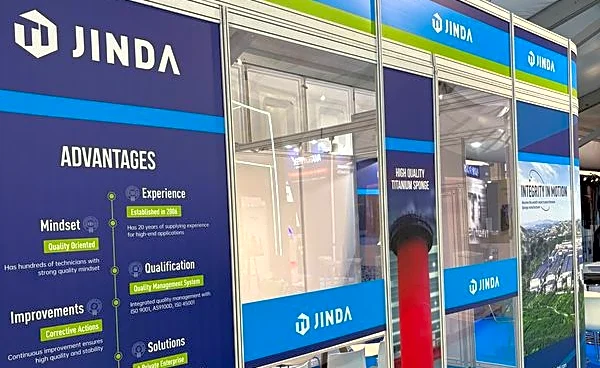
Close to two dozen Chinese firms, including HST Titanium, Jinda Titanium and Baoji YongshengTai, showcased products ranging from titanium sponge and ingots to ceramic brake plates at Farnborough, seeking to expand beyond a domestic market dominated by emerging planemaker COMAC in a record Farnborough showing.
"There's strong internal competition in China and they want to find a larger overseas market," said Karolina Jackiewicz, a special metals trader at CCMA, a raw materials distributor which advises Chinese suppliers.
CHINA SEEKS TO OVERCOME TRUMP TARIFFS
While U.S. tariffs on Chinese titanium initially hurt suppliers, industry executives said they still see opportunities in the United States, where supplies have been constrained and domestic production has ceased.
Interest was also strong in Europe. At least three Chinese suppliers, who asked not to be named, said their titanium was being used on Airbus aircraft.
Airbus did not respond to a Reuters request for comment on its use of Chinese titanium.
Aviation analyst John Strickland said the strong Chinese presence at Farnborough — one of the world's largest aerospace events — highlighted a renewed push to expand in Western markets.
“They're making contacts. They're networking. They're explaining their product. They're showcasing their product,” he said.
Chinese aerospace and defence firms had a broad presence across the air show, led by COMAC, which is trying to challenge Boeing and Airbus in commercial aviation but remains reliant on foreign suppliers for key technologies, including jet engines.
Strickland said he expects COMAC and Chinese aerospace suppliers to play a growing role globally, though they will need to build the support ecosystem that underpins Boeing and Airbus's success, including maintenance and repair networks, spare-parts distribution, engineering support and aircraft leasing services.
"If they deliver their planes … in terms of reliability, performance, and in particular a market that shows that they can develop infrastructure support globally, because that's what airlines want,” Strickland said.
(Reporting by Joanna Plucinska and Shivansh Tiwary; Editing by Joe Brock and Sharon Singleton)