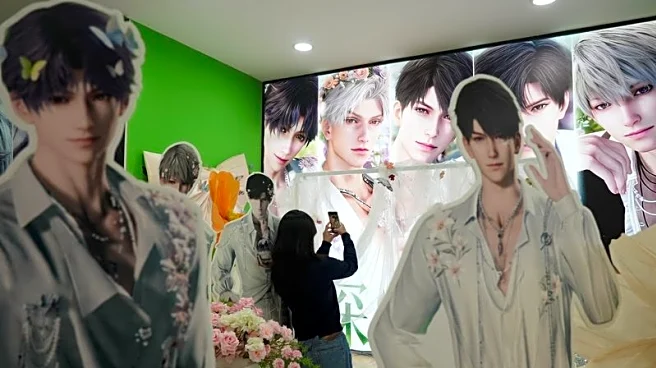




SHANGHAI/GUANGZHOU, Feb 12 (Reuters) - When Zhou, a 33-year-old Chinese civil servant, was a student, finding love and companionship was something she believed would happen with time.
Today, her emotional needs are fulfilled by Qi Yu, her first boyfriend and partner of six months. He's wavy-haired, handsome and a painter. He's also fictional - one of five romantic interests to choose from in "Love and Deepspace", the world's biggest mobile dating game with some 80 million users, according to research
firm Sensor Tower.
"The process of getting to know him is incredibly fulfilling," said Zhou, who declined to give her full name.
Qi Yu, known as Rafayel in the English version, is also a sea god, one of the last members of an ancient race and is not fond of most humans. The virtual version of Zhou - who Qi Yu will hug, kiss and hold hands with - is created using her own face and voice but is also assigned a new identity such as a huntress.
Zhou plays "Love and Deepspace" - an action fantasy as well as a romantic game - for about an hour a day and has spent more than 10,000 yuan ($1,400) on it so far, mostly on limited-edition features that unlock further storylines.
Last month, she flew from her home in the southern Chinese city of Guangzhou to Shanghai, donning a baby-pink sequined gown to meet models dressing up as the characters at an event organised by the developer, Papergames.
BIG REVENUE EARNER
Released in 2024, "Love and Deepspace" belongs to the "otome" genre of romance simulation games that originated in Japan in the 1990s - a genre that has since become huge in China and is growing in popularity in the West.
It had made about $825 million in revenue globally as of last April, China state media have reported, with some estimating that its total revenue to date now stands at nearly $1 billion.
China accounts for around 60% of the game's revenue, followed by the U.S. at 19% and Japan at 9%, estimates from App Magic show.
Papergames declined to comment on its earnings figures.
The popularity of otome games in China reflects a highly developed gaming industry and its desire to transform digital intimacy into financial opportunities, as well as the growing economic power of Chinese women, said Tingting Liu, an academic specialising in China's digital media at the University of Technology Sydney.
"Many women nowadays have the financial means and cultural confidence to invest in experiences that prioritize their emotional needs and desires," she said.
MAKING UP FOR REAL-LIFE SHORTCOMINGS
Evina Li, a 31-year-old worker from Shanghai in the tech industry, is another fan who has spent some 8,000 yuan on "Love and Deepspace" despite having a real-life boyfriend.
She likes it because the game "places women's needs in a very important position", adding that it makes up "for certain shortcomings in real-life interactions between men and women".
Zhou said she was not ruling out finding a real boyfriend and getting married but she had reached a stage in her life where she was no longer anxious about doing so.
"If I make such a hasty decision, I'll definitely regret it," she said.
"But with a male lead in a game, when I need you, I open the game and see you; when I don't, I close the game and do my own thing. I feel like I've gotten used to this kind of lifestyle more and more."
(Reporting by Chenxi Yang and Nicoco Chan in Shanghai and Guangzhou; Additional reporting by Laurie Chen in Beijing; Editing by Laurie Chen, Brenda Goh and Edwina Gibbs)