
By Javier Andres Rojas and Camilo Cohecha
BOGOTA, Feb 10 (Reuters) - Millions of Colombian roses arrived in the U.S. just in time for Valentine's Day, but growing economic challenges are threatening to
wilt the romance for the world's second-largest flower exporter.
Colombia, which trails only the Netherlands in global exports, shipped approximately 65,000 tons of fresh-cut blooms between January 15 and February 9. The Valentine's Day season typically accounts for 20% of annual sales for a sector that serves as the primary supplier to the U.S. market, according to industry group Asocolflores.
But the holiday rush is being overshadowed by a 10% U.S. tariff imposed last April as part of President Donald Trump's broader trade measures. The U.S. accounts for about 80% of Colombia's flower exports.
Growers are also battling a peso that has strengthened almost 12% against the dollar over the past year and a 23% rise in minimum wage, factors that are eroding competitiveness and squeezing margins.
"We are in very adverse, very complicated situations," said Jose Antonio Restrepo, manager of Ayure SAS Eclipse Flowers near Bogota. Without a shift in economic conditions, he warned, the industry could face widespread layoffs and farm closures by July.
Flower cultivation is the country's most labor-intensive agricultural sector, providing formal employment for roughly 240,000 workers across 10,500 hectares, or nearly 26,000 acres.
Flower growers face another unlikely challenge this year: Valentine's Day falls on a Saturday.
"It's preferable that Valentine's Day falls on a weekday because people are accustomed to sending flowers to offices as a surprise," explained Augusto Solano, president of Asocolflores.
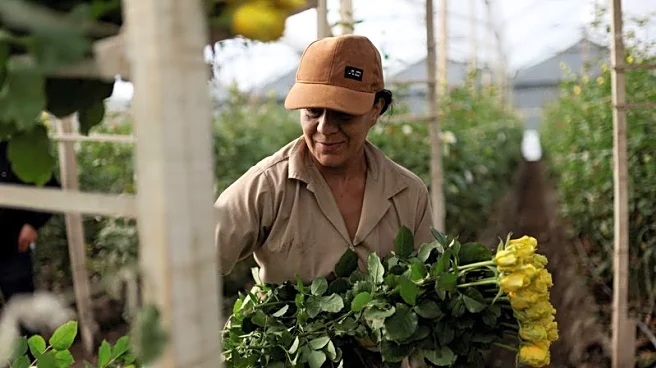
On the packing floor at Ayure SAS Eclipse Flowers, the mood was more upbeat. Susana Vega, who was wrapping a bundle of roses, said the holiday still brings a sense of purpose.
"It's an immense joy (...), knowing that we're bringing happiness to someone," Vega said. "To a woman, to a mother, and that we're also benefiting ourselves."
(Reporting by Javier Andres Rojas and Camilo Cohecha; Writing by Nelson Bocanegra and Natalia Siniawski; Editing by Ethan Smith)