
By Juveria Tabassum and Arriana McLymore
NEW YORK, Jan 8 (Reuters) - The $2.7-billion marriage of Saks and Neiman Marcus was meant to create a powerhouse in the world of luxury department stores, helping
it fight competition from online players and rivals such as Bloomingdale's and Nordstrom.
A year on, it has instead left the enlarged company contemplating court protection under mounting debt and sluggish store traffic.
Canada-based conglomerate Hudson's Bay Co, which had owned Saks since 2013, bought rival Neiman Marcus along with storied New York retailer Bergdorf Goodman in July 2024 and spun off its U.S. luxury assets to create Saks Global, crowning previous merger attempts and bringing together three names that have defined American high fashion for over a century.
Big names such as Amazon and Salesforce blessed the deal by becoming equity investors.
Yet the merger, led by HBC chairman and NRDC Private Equity founder Richard Baker, was built on shaky ground. Saks took on about $2.2 billion of debt to fund its acquisition of Neiman Marcus, raising some concerns considering the company was loss-making amid a global luxury sector slowdown.
Meanwhile, top brands started to sell more aggressively in directly-controlled shops, giving consumers less reason to go to Saks and Neiman, exacerbating the already frail debt structure, according to a consumer and retail banker.
"The deal was built on aggressive earnings and cost-cut assumptions that have not been achieved, while the added leverage has proven difficult to sustain in a structurally shrinking retail sector," said Tim Hynes, Global Head of Credit Research at financial intelligence firm Debtwire.
DOOMED FROM THE GET-GO
Saks targeted $600 million of annual cost savings over the next five years thanks to the combined company's scale, according to media reports citing the company's investor call in October.
However, the luxury sector did not recover in 2025, and servicing debt became harder, forcing the conglomerate to tap investors for a further $600 million in June.
"I don't believe they had enough capital initially put into the company after the acquisition to ride out the period of time it takes to actualize savings. So started to run out of cash," said Gary Wassner, CEO of New York-based factoring firm Hilldun, which buys unpaid invoices from retailers and is owed several million by Saks Global.
By October, Saks Global had cut its full‑year adjusted core earnings target to $140 million to $160 million, down from an earlier $275 million to $325 million range, according to a Bloomberg report, citing its investor call at the time.
Saks did not respond to multiple Reuters requests for comments for this story. Amazon declined to comment on Saks' financial troubles, while Salesforce did not immediately respond.
The company was in talks for a $1 billion loan to help keep things running, Bloomberg reported last week.
EMPTY SHELVES, PAYMENTS DUE
Without enough cash, Saks delayed payments to vendors, and ended up receiving products nearly a month later than rivals, affecting its ability to sell them at full price, Wassner and former vendors told Reuters.
Over the past year, vendors began pulling back orders to Saks, and as of January, over 100 brands had stopped shipping product to the company, and Hilldun paused approving orders in early December, Wassner said.
A source at a ready-to-wear women's fashion brand, who declined to be named because of confidentiality issues, said the brand stopped sending merchandise to Saks in December, and hasn't received a six-figure payment from the company since August. A watch company which sold at Saks on Fifth Avenue told Reuters it had ended the relationship because Saks was late on paying it at least $70,000. In the end, the cash ran out, despite trying to sell a minority stake in Bergdorf Goodman in September, and Saks missed a $100 million interest payment in December, raising the prospect of a Chapter 11 filing.
The company has 30 days to make those payments, during which it can try to work with creditors to formulate a plan to restructure its finances, said Debtwire's Hynes.
Wassner said Hilldun would submit claims to the trustee of the bankruptcy court to be on Creditors Committee if the company does file for bankruptcy protection.
Real estate mogul Baker replaced veteran Marc Metrick as Saks Global's new CEO late in December. He also owned Canada's 300-year-old department store chain Hudson's Bay and Manhattan-based Lord & Taylor. Both folded, joining a long list of luxury retail chains which have crumbled in the last decade. Baker also owns Germany's Galeria Karstadt Kaufhof.
Despite the sector's struggle, investors continue to value prime real estate. Saks Global's property portfolio, which includes nearly 13 million square feet of gross leasable area in the U.S., is worth nearly $4 billion, according to S&P Global estimates.
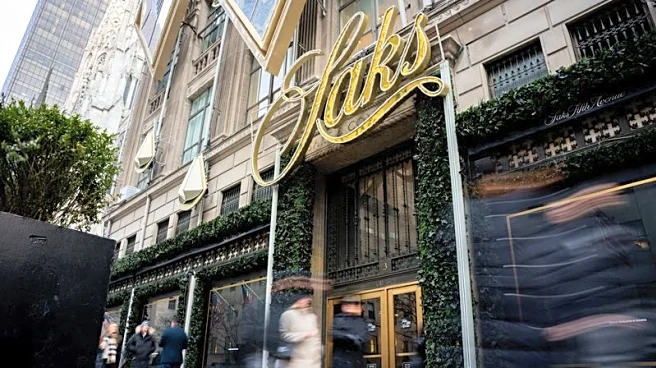
"The big question will be the future of the iconic Fifth Avenue flagship. While it may survive an initial restructuring, the highest value for that land is certainly not as a retail store," Debtwire's Hynes said.
(Reporting by Juveria Tabassum in Bengaluru and Arriana McLymore in New York, additional reporting by Abigail Summerville in New York, editing by Lisa Jucca and Nick Zieminski)