





By Jonathan Stempel
Aug 8 (Reuters) - Berkshire Hathaway said it began reducing its enormous stockpile of cash in the second quarter, investing billions of dollars in stocks such as Alphabet and repurchasing billions of its own, as it reported higher-than-expected profit.
The conglomerate said on Saturday it repurchased $4.5 billion of its own stock between April and June and over $3.3 billion more in July, accelerating repurchases it had begun in March following a nearly two-year hiatus.
It also bought
nearly $20 billion more stocks than it sold, ending 14 straight quarters as a net seller of shares.
Purchases included a $10 billion addition to Berkshire's already-large investment in Alphabet, the parent of Google and YouTube, which is now one of its largest stock holdings.
Quarterly operating profit rose 16% to $12.98 billion, topping analyst forecasts, as improvement at the BNSF railroad and service businesses including the NetJets luxury plane unit and TTI electronic components distributor helped offset weakness at the Geico auto insurer. Revenue, which had been stagnating, rose 10% to $101.81 billion.
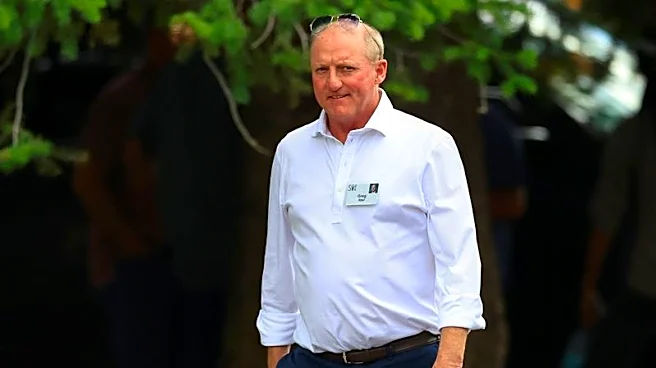
The quarter was the second since Greg Abel became Berkshire's chief executive, succeeding Warren Buffett, who remains chairman.
"It's a pretty healthy beat, and investors will be encouraged," said Cathy Seifert, an analyst at CFRA Research with a "neutral" rating for Berkshire. "Slowly, gradually and subtly we're seeing Greg assert himself as the new leader."
MEASURING INTRINSIC VALUE
Investors and analysts have been eager to see how Abel's approach to managing Berkshire's capital differs from that of Buffett, who had difficulty deploying cash toward the end of his 60 years at the helm of the Omaha, Nebraska-based conglomerate.
Berkshire ended June with $364.7 billion of cash, down from a record $380.2 billion three months earlier.
Berkshire's policy allows buybacks when the stock price is below intrinsic value, as "conservatively determined" by Abel following consultation with Buffett.
Buffett told CNBC last month he remains involved in Berkshire's decision-making, and neither he nor Abel were doing anything that the other didn't approve of.
The pace of stock repurchases is comparable to Buffett's peak pace early this decade.
Berkshire's biggest year for buybacks was 2021, when it repurchased $27 billion of stock.
NET INCOME MORE THAN DOUBLES
The $12.98 billion of operating profit equaled about $9,068 per Class A share, and grew from $11.16 billion a year earlier.
Berkshire's net income more than doubled to $25.67 billion, or about $17,928 per Class A share, from $12.37 billion.
Net results include unrealized gains and losses on Berkshire's $323.8 billion stock portfolio, including stocks Berkshire has no plans to sell. This adds volatility to earnings, and Berkshire believes those gains and losses are usually meaningless.
The cash stake includes the $6.8 billion that Berkshire spent in late July to buy home builder Taylor Morrison.
Berkshire's Class A shares have lagged the Standard & Poor's 500 by 40 percentage points since Buffett announced in May 2025 that Abel would replace him as chief executive at year end. In 2026, the shares have risen 3%, while the S&P 500 is up 13%.
(Reporting by Jonathan Stempel in New York; Editing by Sharon Singleton and Susan Fenton)