








By Rajesh Kumar Singh
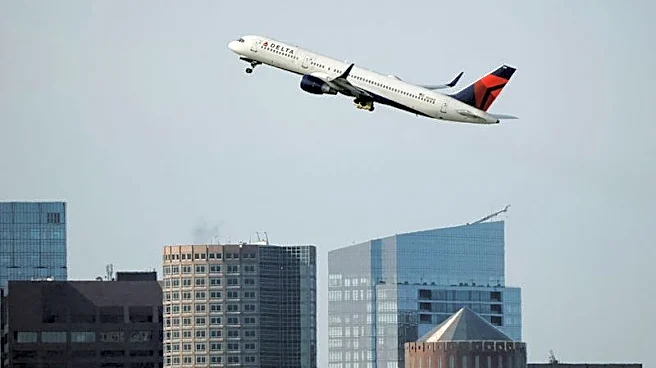
CHICAGO, July 10 (Reuters) - Delta Air Lines reaffirmed its full-year profit forecast and gave a stronger-than-expected third-quarter outlook on Friday, signaling confidence that recent fare gains can hold even as fuel prices ease from this year's highs.
The outlook from the first major U.S. carrier to report results offers an early read on whether airlines can preserve fare increases pushed through during the spring fuel shock as costs moderate.
Delta Chief Financial Officer Erik
Snell said the carrier recovered about 60% of the fuel cost increase in the second quarter, faster than it has historically, and it expected to recover more this quarter.
"Demand continues to be strong and there are no signs of weakness or shift in patterns in demand," Snell told reporters. "We haven't seen elasticity."
Carriers raised fares this spring during a surge in jet fuel prices tied to the Iran war. Fuel has since retreated from its peak, but airline investors are watching whether lower costs lift profits or carriers add back too much capacity after summer and weaken pricing.
Delta forecast 2026 adjusted earnings of $6.50 to $7.50 per share, reaffirming the range it first issued in January after leaving it out of its April first-quarter release. The $7 midpoint is about 17% above the $5.97 per share expected by analysts surveyed by LSEG.
Snell said fuel price volatility would be a major factor in whether Delta lands at the upper end of its range, while the airline expected revenue strength to continue through year-end.
The carrier forecast third-quarter adjusted earnings of $2.00 to $2.50 per share, compared with analysts' average estimate of $2.02. It expects mid-teen revenue growth and an operating margin of 11% to 13%.
Delta's biggest rivals, United Airlines, American Airlines and Southwest Airlines, will report their results later this month.
FARE GAINS HOLD
Delta's results suggest airlines are driving revenue growth through pricing rather than capacity expansion.
The airline reported revenue growth of nearly 14% in the second quarter on only about 1% capacity growth.
Passenger revenue per available seat mile — a measure of how much revenue Delta generates for each seat-mile of capacity — rose 11% in the second quarter from a year earlier.
Snell said Delta's third-quarter volume would be roughly flat to slightly higher from a year earlier, suggesting its revenue growth is being driven more by fares and passenger mix than by additional flying.
Premium revenue rose 17% in the second quarter, but main-cabin ticket revenue also grew 8%, supporting Delta's view that demand remains strong beyond its highest-paying customers.
POST-SUMMER TEST
Analysts say the bigger test for airlines will come after the Labor Day holiday in September, when leisure travel typically softens.
They warn that fourth-quarter capacity plans remain the biggest risk to current fare strength. If too much flying returns at once, carriers could undercut the pricing gains they secured during the fuel shock.
Snell said the airline can adjust flying close-in if demand deteriorates, as it did in the second quarter.
FUEL RELIEF NARROWS
Higher fuel costs led to a 26% decline in Delta's second-quarter adjusted earnings to $1.56 per share from a year earlier. It still topped analysts' expectations of $1.48.
Delta said it absorbed the highest quarterly fuel expense in its history, up $1.9 billion from a year earlier.
Snell said Delta's fuel bill would be about $4 billion higher this year than last year. For the third quarter, it is assuming a fuel price of about $3.15 a gallon.
U.S. spot jet fuel has climbed to $3.18 a gallon, the first time it has moved back above the $3 mark since mid-June, amid renewed hostilities between the U.S. and Iran. Prices remain well below an early-April peak of roughly $4.88 per gallon.
(Reporting by Rajesh Kumar Singh; Editing by Jamie Freed)