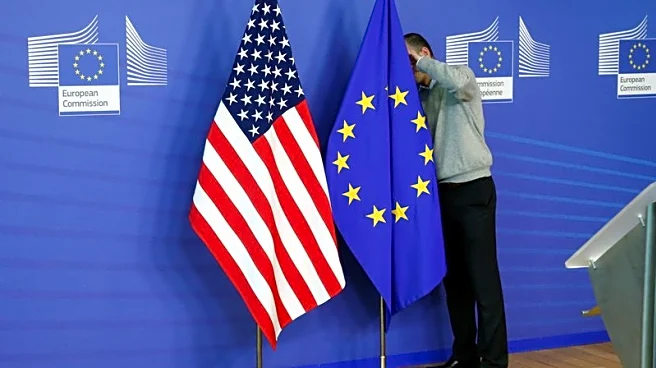

BRUSSELS, Feb 11 (Reuters) - European Union leaders will discuss on Thursday what to do to help Europe become less economically dependent on the United States and China to be less vulnerable to economic coercion.
Below are the main areas for the leaders' discussions, as outlined by the meeting chairman Antonio Costa.
1. BRING DOWN BUREAUCRATIC BARRIERS
These barriers limit trade in goods and services, having the same effect as if there were internal tariffs of 44% on manufactured goods and 110% on services.
2. PAVE THE WAY FOR EU COMPANIES TO SCALE UP
The EU needs bigger firms so that they can compete globally with large U.S. and Chinese enterprises, benefit from economies of scale and afford costly research and development.
3. PROTECT STRATEGIC INDUSTRIES
This would include a European preference in sensitive sectors like clean-tech and renewable energy, defence and aerospace, semiconductors and chips, critical raw materials, digital technologies and artificial intelligence, energy-intensive industries, biotech and pharmaceuticals and automotive industry.
4. STAY OPEN FOR TRADE
Because of trade tensions with China and the United States, the EU is racing to secure trade deals with other countries and regions to secure stable trade alternatives.
In just over a year, the EU has concluded trade deal negotiations with Mexico, Mercosur, Indonesia, Switzerland and India and deals with Australia, Thailand, the Philippines and the United Arab Emirates are in the pipeline.
5. TACKLE STRATEGIC DEPENDENCIES
The EU is heavily dependent on the U.S. for defence and for digital services like entertainment streaming platforms, payment services like Visa and Mastercard or capital market services.
The EU heavily depends on China for rare earths, processing of critical minerals, solar panels, wind turbines, and generally manufactured parts for its supply chains.
EU leaders are to discuss how to establish a preference for European-made goods when purchased with public money, rebuild Europe's own defence industry, diversify suppliers, develop their own artificial intelligence capabilities, introduce the digital euro for digital payments and develop an EU-wide capital market.
(Reporting by Jan Strupczewski; editing by Philip Blenkinsop, William Maclean)