



By Anne Kauranen, Elviira Luoma and Christoph Steitz
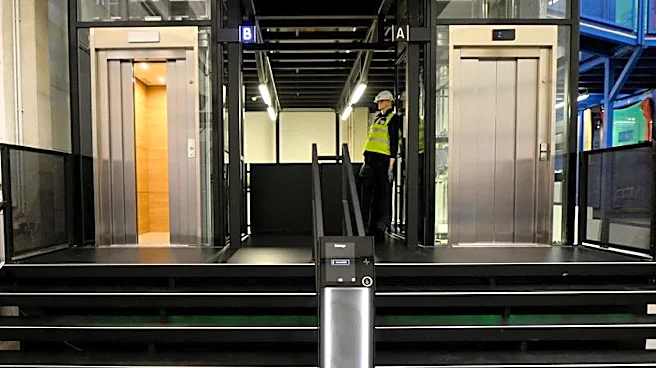
HELSINKI/GDANSK/FRANKFURT, May 4 (Reuters) - Brussels' antitrust rules have already once helped derail an attempt to create the world's top lift maker, but Kone's proposed new tie-up with TK Elevator shows the Finnish group is banking on a change in Europe's approach to forging regional champions.
People familiar with the deal say a planned revamp of European Union merger rules - which would give companies more leeway in pursuing continental tie-ups
to match the scale of U.S. and Asian rivals - could be supportive of Kone's plans.
Last week's bid marks Kone's second attempt in six years to take on Germany's TKE after it abandoned its previous 17 billion euro ($19.92 billion) joint non-binding offer with CVC Capital Partners in part because of antitrust concerns.
The former division of ThyssenKrupp was eventually taken over by private equity firms Advent and Cinven.
CREATING 'GLOBAL TOP TIER'
Responding to the announcement of the deal, which if approved would make the combined company the world's number-one lift and escalator maker by market value, Finnish Prime Minister Petteri Orpo said Europe needed more companies in the "global top tier."
Danske Bank equity analyst Panu Laitinmaki said he believed the deal would receive the necessary regulatory approvals, but like other analysts expected Kone might need to sell some of its European operations to satisfy regulators.
"The EU's stance on major European mergers appears to be shifting, and I see better chances for the deal to go through now than a few years ago," he said.
Asked for a comment, a spokesperson for the European Commission said the proposed transaction had not been formally notified, and it was up to the companies to do so regarding mergers with an EU dimension.
Under the EU's proposals, companies will be able to argue for their deals by bringing up the benefits of sustainability, resilience, investment and innovation as a counterweight to regulators' traditional focus on consumer harm and competition.
However, such concerns are still expected to draw lengthy EU antitrust scrutiny to the deal, which would reduce Europe's competitive landscape to three from four players, and one that Swiss rival Schindler has already said it would challenge. Moreover, the new measures might not come into effect soon enough to apply to this deal.
A merger between Kone and TKE, which one person familiar with the deal said has been pondered for decades, would create a company with about 20 billion euros in annual sales, more than 100,000 employees worldwide, and a market value just shy of 49 billion euros, according to Reuters calculations.
That would vault it well ahead of Schindler's $36 billion, and U.S.-based Otis, valued at almost $30 billion at Thursday's market close.
The deal would also strengthen Kone's presence in the Americas, where TKE is stronger, and bring about 700 million euros in annual savings.
Presenting the deal on Wednesday, Kone's CEO Philippe Delorme said he was confident that the company would receive all regulatory approvals by working with regulators, but refused to share any details on the potential need for remedies.
Kepler analysts said the nature of the business meant market-by-market and segment-by-segment reviews seemed unavoidable, with regulatory clearance in the U.S., Britain and other regions also required.
"Elevators are often procured locally or nationally, and regulators would likely look separately at new installations, modernization, maintenance."
Kepler analysts said a so-called phase 2 probe - a full-scale investigation that signals deeper EU competition concerns and typically requires remedies - was highly likely.
Analysing the deal's potential impact on profitability, Citi looked at a scenario where the combined entity could end up selling the German business plus other European assets worth a further 500 million euros in sales.
Analysts said Europe was not the only region of concern.
"Any potential reviews could also take a country-by-country approach, potentially demanding divestments of appropriate proportions," said Kulwinder Rajpal of AlphaValue.
Kone said it expected the transaction to complete at the earliest in the second quarter of 2027, subject to approvals, a timeline that Inderes analyst Aapeli Pursimo described as optimistic.
($1 = 0.8532 euros)
(Reporting by Anne Kauranen in Helsinki, Elviira Luoma and Bernadette Hogg in Gdansk and Christoph Steitz in Frankfurt. Additional reporting Andres Gonzalez. Editing by Anousha Sakoui and Tomasz Janowski)