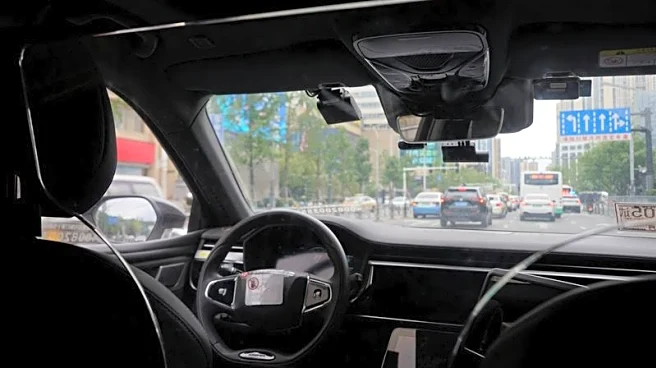

Dec 22 (Reuters) - Uber and Lyft are teaming up with Chinese tech company Baidu to test self-driving taxis in the UK in 2026, making them the latest ride-hailing platforms to partner with self-driving vehicle
firms.
Robotaxis are expected to be a safer mode of transport that can reduce operational costs by minimizing reliance on drivers and optimizing routes through real-time data.
Several cities and countries have positioned themselves as testing grounds for robotaxi services, with deployments for last-mile logistics such as robotic food delivery and daily travel.
Here are some of the major robotaxi tests, trials and operations globally:
UBER, LYFT AND BAIDU
Uber and Lyft partnered with Chinese tech company Baidu in December to test its Apollo Go RT6 vehicles for self-driving taxi trials in the UK next year.
MOMENTA AND GRAB
Momenta partnered with Singapore-based ride-hailing company Grab in December, in a deal that also included an undisclosed investment from Grab.
MERCEDES-BENZ, MOMENTA AND LUMO
Mercedes-Benz teamed up with autonomous driving firm Momenta and UAE taxi operator Lumo to launch a luxury robotaxi service in Abu Dhabi in December. The fleet, based on the Mercedes S-Class model, is slated to begin operations in 2026, with plans to expand to other global markets.
WERIDE AND GRAB
Chinese robotaxi firm WeRide and ride-hailing company Grab said Singapore's Land Transport Authority approved autonomous vehicle testing for their Ai.R fleet in Punggol district in November. The partners, who began trials in mid-October 2025, plan to quadruple robotaxi test runs on shuttle routes by year-end.
WERIDE AND UBER
WeRide and Uber launched Level 4 fully driverless robotaxi operations in Abu Dhabi in November, starting public rides on Yas Island under a permit-backed rollout. Passengers can book rides via Uber Comfort, UberX, or the new “Autonomous” category, marking Uber's first dedicated self-driving option globally.
WERIDE IN ZURICH
WeRide secured a driverless robotaxi permit from Switzerland's regulator in November for operations on public roads in Zurich's Furttal region, with safety-driver testing underway and fully driverless passenger service expected to launch in the first half of 2026, and subsequently expand the fleet to include Robobuses.
ZOOX IN SAN FRANCISCO
Amazon's self-driving arm Zoox began offering free rides to select early users in parts of San Francisco, the company said in November. Zoox is inviting people from its waitlist to try its point-to-point service in South of Market, Mission District and Design District neighborhoods to fine-tune the experience before a broader rollout.
BAIDU IN SWITZERLAND
Baidu's Apollo Go partnered with Swiss Post's PostBus in October to launch the AmiGo robotaxi service in eastern Switzerland. Testing will start in December with a pilot fleet mapping routes under safety drivers. Early 2026 will see limited pilot rides with safety drivers, followed by driverless trials in late 2026. Full operations are targeted for early 2027.
PONY.AI AND THE XIHU GROUP
Chinese autonomous driving firm Pony.ai received Shenzhen's first city-wide permit for commercial driverless robotaxi services in October. The approval, granted jointly to the city's largest taxi operator Xihu Group, will see services start in Nanshan, Qianhai and Baoan before expanding across the city.
WAYMO IN LONDON
Waymo, Alphabet's self-driving unit, said in October it will launch an autonomous ride-hailing service in London in 2026. The company is partnering with mobility fintech company Moove to manage fleet operations, facilities, and charging infrastructure ahead of the rollout.
ZOOX IN LAS VEGAS
Zoox launched its autonomous ride-hailing service on and around the Las Vegas Strip in September 2025, offering rides to the public for free while waiting for state approval to collect fares. The vehicles will run on their own, with remote human assistance available only when the vehicle requests help.
WERIDE IN GUANGZHOU
WeRide's mass-produced Robotaxi GXR has begun 24-hour fully driverless commercial operations in Guangzhou's Huangpu district in September 2025.
WERIDE IN SINGAPORE
WeRide, in September, said it has started testing its GXR robotaxis at Singapore's Centre of Excellence for Testing & Research of Autonomous Vehicles, which opened in 2017 by Nanyang Technological University. The company plans to roll out the service on designated public roads by the end of 2025, pending regulatory approvals.
PONY.AI IN SHANGHAI
Pony.ai, in partnership with Shanghai Jinjiang Taxi, launched driverless ride-hailing services in Shanghai in August. The rollout followed the issuance of eight demonstration permits at the World Artificial Intelligence Conference. The company currently operates robotaxis in designated areas of Pudong's Jinqiao and Huamu.
PONY.AI IN BEIJING
Pony.ai, in July, said its seventh-generation Beijing Automotive Industry Corporation (BAIC) robotaxi began road tests in Beijing, with multiple vehicles now operating in the city's 225-square-kilometer High-Level Autonomous Driving Demonstration Zone. The trials mark progress toward large-scale production and commercial rollout, the company said.
TESLA IN AUSTIN
Tesla began a limited paid robotaxi rollout in Austin, Texas, in June, using Model Y SUVs within a restricted city area, requiring a safety monitor onboard. The Elon Musk-led company is testing its vehicles without safety monitors onboard the vehicle.
WAYMO IN TOKYO
Waymo partnered with Japanese taxi and limousine operator Nihon Kotsu in April 2025 to test autonomous vehicles in Tokyo, with Nihon Kotsu drivers manually operating the cars during the initial phase in seven Tokyo wards, including Minato and Shibuya.
BAIDU AND AUTOGO
Baidu's Apollo Go partnered with UAE-based autonomous mobility company Autogo in March to test self-driving vehicles in Abu Dhabi with the city's Integrated Transport Centre, with plans to expand gradually, leading to commercial operations by 2026.
PONY.AI IN GUANGZHOU
Pony.ai launched paid robotaxi services in Guangzhou in February 2025, offering paid rides from multiple city-center locations to Guangzhou Baiyun International Airport and Guangzhou South Railway Station. The company was the first approved to operate on these high-demand routes.
PONY.AI IN HONG KONG
Pony.ai, in January, said it planned to provide robotaxi operations in Hong Kong, initially serving airport staff within Hong Kong International Airport before expanding into other urban areas in the city.
BAIDU IN HONG KONG
Baidu secured a permit to test its Apollo Go robotaxi in Hong Kong in November 2024. The approval allows the company to trial 10 autonomous vehicles in North Lantau, according to a statement released by Hong Kong's Transport Department.
WAYMO IN LOS ANGELES
Waymo One fully rolled out in Los Angeles in November 2024, offering 24/7 autonomous rides across an 80-square-mile area including Santa Monica, Hollywood Boulevard, and the University of Southern California, after successful trials.
UBER AND WAYVE
Wayve, a British self-driving tech firm backed by SoftBank and Nvidia, partnered with Uber in August 2024 to bring AI to start advanced trials in the UK with plans to begin driverless tests in 2026.
WAYMO IN SAN FRANCISCO
Waymo commercially launched its all‑electric fleet of Jaguar I‑PACE SUVs across the city in June 2024. Passengers can avail the service throughout the San Francisco peninsula, in vehicles equipped with sensors and cameras. Waymo has surpassed Lyft's market share in the San Francisco Bay Area ride-hailing market, according to multiple third-party data providers.
BAIDU IN SHENZHEN
Baidu obtained a license to operate fully driverless ride-hailing services in Shenzhen in June 2023, making it the fourth Chinese city after Wuhan, Chongqing, and Beijing to allow such services. The license lets Baidu's robotaxis run without safety operators on board.
BAIDU IN CHONGQING AND WUHAN
Baidu secured China's first permits to offer commercially fully driverless robotaxi services to the public in August 2022. The approval allows its Apollo Go service to operate without safety drivers in Chongqing and Wuhan.
WAYMO IN PHOENIX
Waymo launched its fully driverless robotaxi service in Phoenix in October 2020. The company began offering rides in minivans with no human attendant on board in a phased rollout.
(Reporting by Arnav Mishra and Anhata Rooprai and Akash Sriram in Bengaluru; Editing by Alan Barona)