









By Saqib Iqbal Ahmed and Lewis Krauskopf
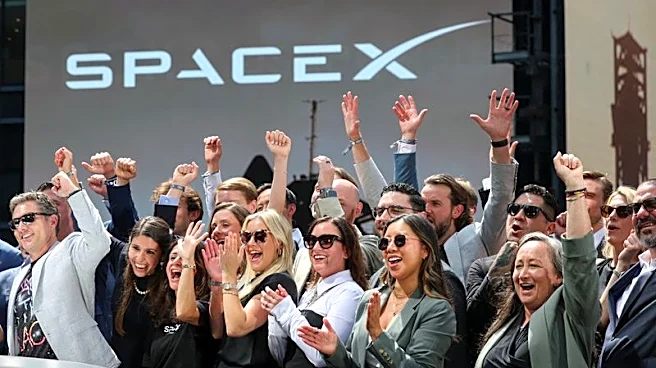
NEW YORK, June 23 (Reuters) - SpaceX's stock extended its wild ride on Tuesday, briefly falling below its first-day opening price before rebounding on an otherwise weak day for the tech sector – sharpening Wall Street’s focus on the shifting balance between buyers and sellers of the volatile shares.
Shares of Elon Musk’s rockets-and-AI firm have surged as much as 67% since they started trading on June 12 and fallen 35% from there. But those swings don't likely
represent a fundamental shift in investors’ views on SpaceX’s prospects and valuation, analysts said, given the flood of information that preceded its record $75 billion IPO and the silence that has followed.
That will change in coming days. SpaceX’s addition to major indexes and the start of research coverage by major investment banks is likely to fuel more buying, while the expiration of share lockups could drive potential selling, analysts said.
Options-market activity has grown more defensive, with more investors betting on potential share declines after an initial bout of euphoric buying of SpaceX. Often, automatic sell orders cluster around specific milestones, with some identifying the June 12 opening price of $150 and the $135 IPO price as potential pain points.
Tuesday was another up-and-down day for the stock. Shares were lately up 5% at $162.80, after earlier trading as low as $147.11 amid a broader Nasdaq selloff.
"If these levels hold, it will be viewed optimistically as a 'test', but if they break, it could mark a sentiment shift for the more high-flying areas of the market," Bespoke Investment Group said in a note on Tuesday.
SpaceX’s selloff in recent days has been accompanied by the biggest tech pullback in several weeks, with Nvidia dropping back below $5 trillion in market value on Tuesday and hundreds of billions of dollars being knocked off the Nasdaq composite index.
RED-LETTER DAYS FOR SPACEX
A series of SpaceX events will drive trading in coming days and weeks. Investors said some of the developments are likely to be bullish, such as index additions, but that it’s impossible to say how any of them will affect trading given the many factors that drive securities pricing, particularly in a hot market such as for AI-related shares.
• SpaceX is expected to be added to Russell indexes as part of FTSE Russell's regular index reconstitution on Friday. That could result in $2.68 billion in inflows from passive investors.
• June 29: Scheduled 13th flight of SpaceX Starship.
• July 6: Expected addition to the Nasdaq 100 index.
• July 7: End of quiet period that limits publication of research by investment banks involved in the IPO.
• SpaceX's inclusion in ETFs like the Invesco QQQ Trust and iShares Russell 1000 ETF, which are tied to the Nasdaq and Russell indices.
The addition to those ETFs has been anticipated by the market, said Todd Rosenbluth, head of research and editorial at TMX VettaFi, an ETF market analysis firm. "However, these ETFs will still be buyers on the day of inclusion, providing some demand for the stock," he said, as index funds, unlike active managers or individual investors, cannot trade far in advance.
OPTIONS BETS GO BOTH WAYS
Investors' initial rush to get exposure to SpaceX through bullish options bets has given way to more two-way action in that market, as some traders brace for the stock to slip below its IPO price in the coming months.
"The options activity has gotten more balanced. It's not as completely euphoric as it was day one," said Steve Sosnick, chief strategist at Interactive Brokers.
Options data show traders ascribing an about 40% probability to the stock trading below $130 by mid-September, according to Susquehanna Financial Group strategist Christopher Jacobson.
While in aggregate SpaceX options still show a slight bullish bias, contracts expiring July through September with strike prices ranging from $125 to $190 show nearly two puts for each open call, according to LSEG data, pointing to defensive positioning. Calls convey the right to buy shares at a fixed price in the future and puts offer the right to sell them.
"I don't think this is unusual given the performance of hot IPOs in the immediate term post offering and the need for hedges surrounding unlock periods," said Ophir Gottlieb, chief executive of Capital Market Laboratories, who has been invested in SpaceX since a funding round in 2022.
While most newly public companies impose broad restrictions on insider sales for roughly six months after listing, SpaceX has created exceptions for some participants and plans a phased release of restricted shares tied partly to company performance and stock-price targets. Some shareholders could begin selling stock shortly after SpaceX reports its first quarterly earnings , provided specified conditions are met.
(Reporting by Saqib Iqbal Ahmed and Lewis Krauskopf in New York; writing by Colin Barr)