
By Evan Garcia
HOUSTON, April 15 (Reuters) - The two professional photography instructors who trained Artemis II astronauts to take pictures of the moon and Earth during their historic lunar flyby said
they were as impressed as the public by the stunning celestial imagery caught on camera.
NASA photography and video trainers Paul Reichert and Katrina Willoughby said they gave the crew roughly 20 hours of special instruction leading up to the April 1 launch of the mission, which marked the first voyage of humans to the moon in more than half a century.
Willoughby and Reichert are both graduates of the prestigious Rochester Institute of Technology's photographic sciences program.
"Most people can use a camera and get a photo that is good enough, but good enough isn't what we're after scientifically," Willoughby said on RIT's news site.
Mission pilot Victor Glover has said the crew's training included on-the-ground drills in which astronauts practiced shooting pictures from inside a mock-up of the Orion capsule using a giant inflatable moon globe suspended in the dark.
Selecting the right tools for the job was key to their success.
The Nikon D5, a digital single-lens reflex model released in 2016, was the workhorse camera used by the crew. Reichert said the D5, used for years on the International Space Station, had proven it would withstand radiation and other extremes of space travel.
"We had a lot of flight experience with it," Reichert told Reuters in Houston on Tuesday. "We knew it could handle radiation, at least several years of radiation dosage on the ISS, and it didn't have any problems with it.”
Another advantage of the D5 was its exceptional performance in low light -- a necessity for capturing crisp images in the inky blackness of space.
One piece of camera equipment used by the Artemis II astronauts is familiar to many amateurs - an iPhone. Willoughby said Apple's iPhone 17 Pro Max was a late addition to the Artemis equipment list. While the handheld, point-and-shoot nature of the phones was useful, the large digital file sizes of the images posed a transmission challenge.
"One thing we do have to think about on board is, 'What does it take to get files down?'" Willoughby said. "And unfortunately, we don't have bandwidth. And that's something a lot of people down here [on Earth] are really used to instantly having."
STRIKINGLY DETAILED STUDIES
Among the more dazzling photos captured by the Artemis crew was an image taken from the moon's far side showing it totally eclipsing the sun, with a soft glow around the blackened orb faint enough to leave pinpoints of light from stars in the adjacent heavens still visible in the darkness.
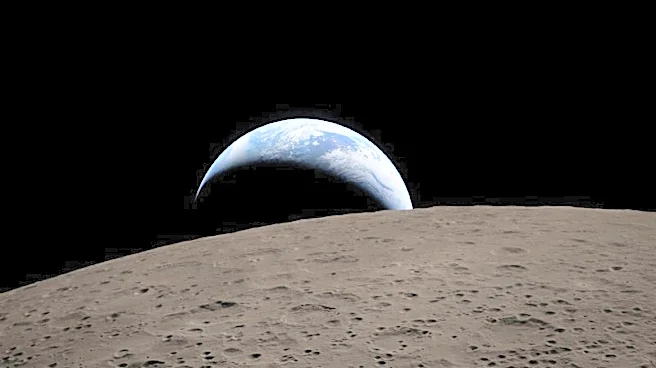
The images also included strikingly detailed studies of the moon's heavily cratered far side, as well as moments in which Earth, dwarfed by the crew's record distance from the planet, set and rose with the lunar horizon as they flew around the moon.
Unlike lunar missions from the Apollo era of more than 50 years ago, Artemis II astronauts benefited from instantly being able to review the digital photos they took, a far cry from the substantial lag time required for developing the conventional film stock that was once used. Moreover, GoPro livestreaming video gave modern Earth audiences a real-time view of space exploration.
Willoughby said the exhilaration on the ground at mission control in Houston during the April 6 lunar flyby was palpable.
“And the excitement in the back rooms and the front rooms as the images were being seen and being put out was pretty good. We were all very excited," Willoughby said.
Besides the D5, the crew also utilized a Nikon Z9 mirrorless camera and several lenses, including a 14-24mm zoom, 80-400mm zoom and a standard 35mm.
(Reporting by Evan Garcia in Houston; Editing by Steve Gorman and Kate Mayberry)