
MILAN, April 20 (Reuters) - Hyundai will not manage to fully make up for lost sales in the Middle East due to the crisis in the region, as manufacturing constraints will not allow the automaker to quickly
reallocate sales to other areas, its CEO said on Monday.
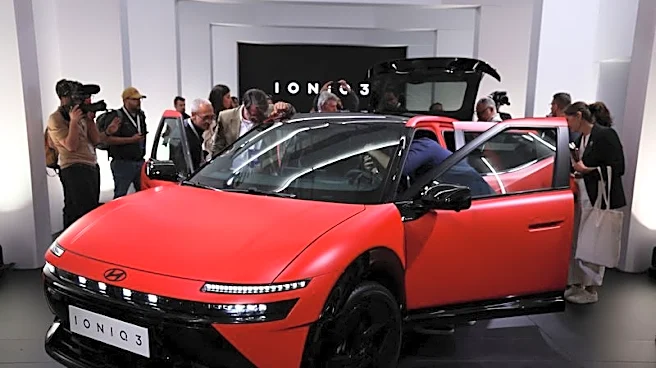
Unveiling Hyundai's new Ioniq 3 EV model at the Milan Design Week in Italy, CEO Jose Munoz said the Middle East was the highest-margin market for the South Korean automaker, although not bringing "mass" profits.
The Middle East conflict was having a significant impact on the carmaker because vehicles produced for the region cannot easily be redirected elsewhere, Hyundai's Spanish CEO said.
"You cannot just simply derive cars that are meant to go from one market to another," he said, also citing different specifications and regulatory requirements across regions.
Hyundai is trying to offset some of the lost Middle East volumes by reallocating cars to other markets, but capacity constraints limit how much it can do in the short term.
"I can tell you that there are many volunteers now that try to get those cars," he said. "One of the regions that can accommodate is the North America region. But there are more as well."
The world's third-largest automaker had been expanding steadily in the region before the crisis, with plans to grow sales in Gulf countries as well as parts of North Africa. Disruptions to logistics have compounded the hit to demand, Munoz said, making recovery dependent on how long the conflict lasts.
"It needs some time to do that. It's not as immediate as reroute the ships from one place to another," he said.
Hyundai, which has been rolling out new electric and hybrid models globally, is also investing heavily in manufacturing and supply chains in Europe and the United States, moves it has said are aimed at supporting long-term growth, backed by localised production, rather than responding to short-term shocks.
Hyundai's Middle East strategy includes building a manufacturing plant Saudi Arabia, which was originally planned to open by the fourth quarter of this year.
"Hopefully we will still be able to open," Munoz said, adding that timeline now depended on developments in the region.
(Reporting by Giulio Piovaccari. Editing by Jane Merriman)