





By Ann Saphir and Howard Schneider
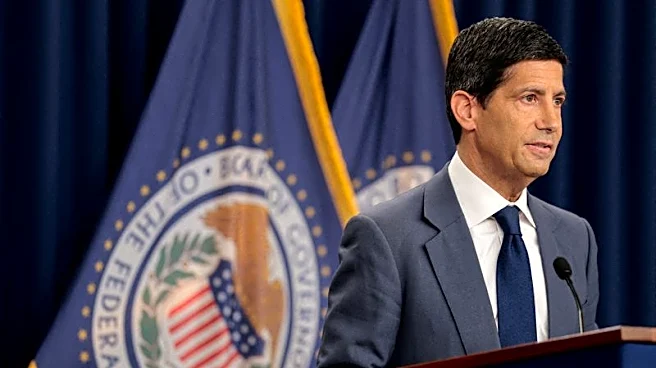
SAN FRANCISCO, Nov 16 (Reuters) - Federal Reserve Chairman Kevin Warsh said on Monday that emerging technologies will have a significant impact on the economy, but the possible scenarios range from rising growth with broadly shared gains to higher unemployment and a potential slowdown if anticipated investment returns prove disappointing.
Warsh refers to artificial intelligence as "super intelligence," the language preferred by President Donald Trump, and said it
could prove distinct from earlier technologies as a force to "supercharge idea generation."
In the best scenario, Warsh told a Fed conference on AI in San Francisco, the technology could lead "to an increase in productivity and economic gains that are shared broadly across labor and the owners of capital. In that event, real GDP growth rises persistently above its long-run average, and the US stays close to full employment."
But Warsh said the risks, including higher unemployment and the use of AI by "bad actors," could also be "highly disruptive and economically costly."
"Our job is to prepare for whatever comes next," he said of the Fed's convening of a group of AI experts to explore the implications of the technology for the economy and central banking.
"Our role in all this is neither advocacy nor opposition. Our responsibility is to recognize that the widespread adoption of this technology will have significant impact on the economy, with important implications for monetary policy down the road," Warsh said. "The big questions are about magnitude, scope, and timing."
The discussion between Warsh and tech industry leaders and academics took place in a San Francisco Fed auditorium before a small invitation-only audience. Those in attendance included Fed Governor Lisa Cook, venture capitalists, money managers, philanthropists, CEOs of technology, healthcare, and other companies, as well as an assortment of economists from across the Fed system, private companies and universities.
While Warsh said the current moment was a "paradigm shift," much of the conversation remained speculative. Panelists discussed how AI might allow the US economy to outpace economies in the rest of the world because of the speed with which new technology and methods are being applied in the US, but also raised concerns that it could undermine learning among students as they become too dependent on the technology.
(Reporting by Howard Schneider and Ann Saphir; Editing by Paul Simao)