





By Shariq Khan
NEW YORK, April 8 (Reuters) - U.S. consumers will continue to pay high prices to fill up their vehicles or purchase airplane tickets through the peak summer travel season, several market experts said on Wednesday, even as wholesale fuel prices cooled after President Donald Trump announced a two-week ceasefire in the U.S.-Israeli war on Iran.
High fuel prices resulting from Iran's blockade of the Strait of Hormuz have become a major issue for Trump and his Republican Party as they campaign
to maintain control of the U.S. Congress in November's midterm elections.
The war has sent gasoline and diesel prices to their highest levels in years, and the economic pain has pushed approval ratings of Trump to the lowest since his return to the White House.
After Trump announced a two-week ceasefire deal on Tuesday, U.S. crude oil futures fell nearly $20, and U.S. gasoline and diesel futures also fell sharply, as traders bet on a potential reopening of the Strait of Hormuz.
But falling crude futures probably will not bring quick relief for consumers at the pumps, experts said, noting that cracks had already begun to appear in the fragile truce. The Strait of Hormuz remained shut on Wednesday after Israel launched its biggest attacks yet on Lebanon. Iran also hit a pipeline that Saudi Arabia has been relying on to bypass the Hormuz.
"There's so much uncertainty still around what this ceasefire means, and when and how fuel starts to flow through the Strait of Hormuz again, retailers are not going to drop prices sharply in the face of those unknowns," said Shon Hiatt, director of the Zage Business of Energy Initiative at the USC Marshall School of Business.
In any case, retail fuel prices rise a lot faster than they drop, as fuel sellers will work through higher-priced inventory and seek a higher degree of certainty of future supply to avoid losses, Hiatt said.
"Prices go up like a rocket, and they fall like a feather."
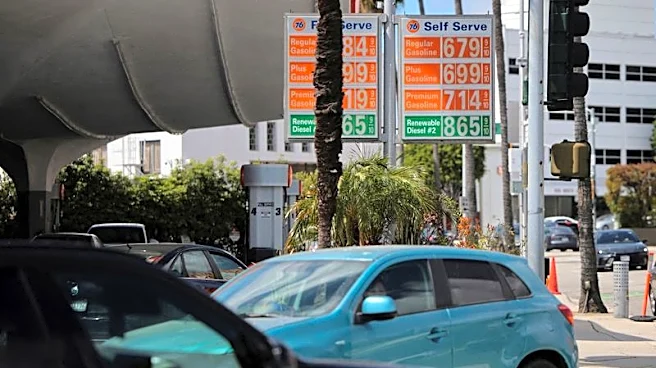
U.S. retail gasoline eased a penny to $4.16 a gallon as of mid-day Wednesday, from a near four-year high of $4.17 a gallon on Tuesday, data from GasBuddy showed.
"If everything were to freeze right now, the national average could fall 5 or 10 cents a gallon for gasoline by this time next week," GasBuddy analyst Patrick De Haan said.
As of Tuesday, the price at the pumps for gasoline remained nearly a dollar higher than last year's average, GasBuddy data showed.
RISK PREMIUM
Regardless of whether the ceasefire holds, insurance costs will be higher than they were before the war and ships will be hesitant to cross the waterway, said Alex Hodes, director of energy market strategy at StoneX.
"Markets still will be elevated throughout the rest of the year with an elevated geopolitical risk premium," Hodes said.
Hodes and Hiatt said diesel and jet fuel markets in particular will remain on edge, as supply of those fuels has been tighter than other refined products.
The Middle East is a key supplier of those fuels and also of the crude oil grades that have the highest yield of those products in refining.
U.S. average retail diesel prices continued to climb on Wednesday despite the ceasefire deal, hitting $5.67 a gallon, the highest since July 2022 and nearly 60% more than last year.
U.S. gasoline futures were down about 9% in intraday trading, with diesel futures down over 14%. Both remained about a dollar higher than pre-war levels. Gasoline futures were trading at $3.01 a gallon, and diesel futures were at $3.83 a gallon.
"That remaining risk premium is a reminder that the vast majority of vessels still aren't transiting the strait of Hormuz as the cease fire plans still need to trickle down to the folks launching the attacks," U.S. fuel distributor TACenergy's trading desk wrote.
(Reporting by Shariq Khan and Nicole Jao in New York; Editing by David Gregorio)